Friday, July 1, 2016

Admirable Audacity: Speaking, Listening, Doing


In his Newbery Award acceptance speech delivered on June 26, 2016, in Orlando, Matt de la Peña told about a girl at one of his school visits who, after getting his autograph, asked, “Ain’t you gonna ask for my autograph, mister?”


And he did ask her for it, holding out his arm for her to sign. Telling the story, he said to all of us in that banquet room: “Because maybe hers is the kind of audacity it takes to be someone when you come from nothing. And maybe that’s the kind of audacity we need to assume in the book world in order to finally give young people hero choices that reflect our current population.


I’ve been thinking a lot about that girl, and what we owe her. I mean “we” collectively, the creators, the curators, the collection developers, the editors and publishers, the librarians and teachers. And not just those of us lucky enough to be in that room on June 26. All of us. Because we do owe her. She is the reason we are able to do what we do. Isn’t she?


I’ve been thinking about the meaning of “audacity” too.


I looked it up. In two different sources. The two primary definitions come down to this:


1) Boldness that is admirable
2) Boldness that is viewed as arrogant or insolent


And I realized that while the call for more multicultural books is viewed through the lens of definition one, the critiques and challenges that demand the content within those books be authentic and culturally specific are too often viewed through the lens of definition two.


We applaud and add our voices to the chorus. Yes, diversity matters!


It doesn’t even feel audacious to say it anymore, although the work of getting it done surely is.


But when critics dare to question some of the results, they speak and they write as a manifestation of definition one, but are often perceived as embodying definition two.


There is something wrong with this. Not some small thing. Some huge thing that too often divides the very people children and teens rely on. Of course there is room for disagreement in critiques of children’s and young adult literature. But there isn’t  room for closed minds. Getting it right—in a single book, in publishing, in libraries and education--is not a proscription but a process, one that isn’t carried out with good intentions alone. There is so much to be gained when those of us who can’t speak from experience listen to those who can, and who do with admirable audacity. (Redundancy intentional.)  


As he called out people to thank in his speech, Matt de la Peña acknowledged his editor and publisher, Jen Besser, saying, “Thank you for taking a chance on publishing this book and for fighting behind the scenes to keep CJ’s dialogue authentic.” He goes on to say, “You understood from the beginning that CJ would switch codes if he was at school. But he wasn’t at school. He was with his Nana on the bus.”


Right there is an example of what I’m talking about. Besser understood and fought for authentic language. The fact that there was resistance that required a fight  is discouraging. The fact that CJ is a child so real I’m sure I’ve met him, even if I can’t quite recall where, is one encouraging end result of the battle. But my adult response to CJ is not the point. At all. What is  the point, and the joy, is that child readers and listeners recognize CJ as someone THEY might know; who recognize in his world the world they inhabit too in one way or another.


Many of us are on a high from the award acceptance speeches we heard at ALA or have read or watched online since the conference. They offered moments that were thought-provoking, and at times transcendent. But will our resulting energized feelings and (renewed) commitment make a difference?


Perhaps. But only if we understand that the voices of people of color and First/Native Nations as writers, as illustrators, as commentators and critics, are essential. And only if we listen openly, actively to what they say.We can’t just wear a button or promote a slogan. We have to take meaningful action every day.  

Maybe that means finding your own allies in the sphere where you work and fighting to get those voices into libraries and classrooms, or into even into print. Maybe that means taking your limited budget and saying “I will” rather than “I can’t” when it comes to making some selection choices. Maybe it means finding the courage to say “this isn’t ok” when reviewing or evaluating books that reflect thinking that has always been racist even if you’re only coming to understand it now (even if it’s by an author you’ve always admired).  Maybe it means saying “I’m scared” but trying anyway--to listen, to learn, to be an ally.


Jen Besser was an admirably audacious ally to an admirably audacious writer.  But most of us are not editors or writers. We are reviewers and librarians and teachers. How can we be audacious? How can more publishers be audacious, too?  Think about that. Think about what you can do. What you’re already doing. Is there room for more? Is there room for different? Because we need more. We need different. Not because there aren’t amazing books. But because we know--we all know--there aren’t enough of them.

That girl who held out her arm for Matt de la Peña to sign needs to be seen now. She needs books now. And she is far from being alone.

Clap Clapping at the CSK Breakfast

If you attended the ALA Annual conference in Orlando earlier this week, I hope you made it a point to attend the Coretta Scott King Award Breakfast on Sunday morning. I have been going to the CSK Breakfast since the mid-1980s, and it's become, without question, my favorite part of the entire conference.  The speeches are always inspiring, uplifting and eloquent, and are always a reminder of why we do the work we do getting books into the hands of children and teens.

This year, Jason Reynolds gave two acceptance speeches, one for The Boy in the Black Suit and another for All-American Boys. Both were excellent, demonstrating his consummate genius with words. His second speech was brilliantly constructed as a poem, the text of which has been printed on the new Coretta Scott King Award blog. Reading the words is one thing, but actually hearing them spoken aloud by Jason Reynolds is another. His delivery was powerful and moving. Luckily, Pat Enciso had the foresight to record it with her video camera, and she has posted it, with Jason's knowledge and permission.

Read the words and watch the video. And then get to work. Buy the CSK Award books and get them into the hands of young readers.

Tuesday, June 14, 2016

An open letter to Patrick Jones and VOYA Magazine

Dear Patrick,
Image credit: Lisa Nowlain


Back in November, you contacted me to offer feedback on an article you would be submitting to VOYA. That article, in which you “think out loud” on the subject of writing characters of color as a White man, was included in the excellent June issue of the magazine (featuring pieces from a veritable who’s who of bloggers, authors and activists, including Debbie Reese, Edi Campbell, and Sarah Park Dahlen). Months later, after looking at your contribution with fresh eyes and with the help of guidance and education from my friends and allies, I can see that I utterly failed you. In retrospect, here are things I wish I’d thought to say to you then:


  • Truly Listen to the voices of people of color and First/Native Nations (POC/FNN)--that part happens with the brain--reflection and thinking--not the ears. Start by reading the other articles in this issue, especially those by Debbie Reese and Edi Campbell, with an open mind to what you can learn rather than through the framework of what you already know.  For a limited time, anyone can read the entire issue for free here.
  • Thank the people who gave you feedback, as it is hard work, and don’t disregard them.  The woman who asked why you didn't put fried chicken and watermelon in one of your books was asking you to consider that perhaps, rather than writing Black people’s humanity, you were only writing--and hoping to capitalize on--the stereotypes.  Be open to criticism as an opportunity to learn something, not a reason to defend yourself.
  • Don’t turn to White people, including Reading While White (RWW), for approval or justification. That’s the easy way out and reinforces systemic, institutional racism. (For my part, I lost sight of the fact that the RWW bloggers are a team and I should have run your early drafts by the other contributors before responding to you.)
  • Don’t reduce complex arguments to either/or. That certainly isn’t what Allie Jane Bruce did in the blog post you reference. It’s not about whether or not you have the “right” to write about POC/FNN; it’s about the responsibility that goes with writing what you choose (and it’s possible that if you take that responsibility seriously, you may discover you’ll choose to write about something different).
  • Yes, we need more books about POC/FNN, but if that’s your reason for writing them, you are positioning yourself as White savior, no matter how genuinely well-intentioned you are.
  • You write, “Teens will read accessible lit fic when they see their lives reflected in it” and go on to reference your own books as mirrors reflecting reality. But you, as a White writer, are not the person who can best reflect their reality, as your pre-readers’ feedback makes clear.
  • I understand your struggle is genuine, yet yours is not the struggle that matters here. What matters are the struggles and the lives of readers hungry to see their truths authentically reflected in books. The very fact that you think of this as an issue that can be “settled” (when you conclude that, moving forward, “I’ll try to write the best book I can, reflecting the diversity around me, but it won’t have a POC as the main character until I’ve settled the issue in my mind”) tells me you are missing this point. And none of us should miss this point. As a White person, if at any point I decide I’ve figured things out when it comes to race and racism, that’s a pretty sure sign I’ve stopped listening. I want to listen, and learn, and be useful as we all struggle with these issues. I hope and trust that you do, too.


As I look at the above list above I see that these are things that I need to do, too. Because while I didn’t make you write this piece, Patrick, I saw it, read it, and told you it was good to go. I am trying to stay quiet and listen to others and learn as much as I can from this experience so that I don’t make these same mistakes again. I feel absolutely sick knowing that something I did led to the publicity your article has created overshadowing the other contributors to this issue of VOYA. How can I now go forward to be a better “Ally for Diversity in Children’s Books,” as the RWW banner reads? By shutting my mouth and re-reading the Twitter commentary generated by this and especially those pieces in VOYA that are so worth celebrating. I didn’t come up with this list on my own, Patrick--this is really a list of things that I learned from reading and really listening to people of color, First/Native Nations people, and my co-bloggers at RWW.  I am grateful to them for educating me, and I thank them for their patience and generosity. I hope that you will join me in doing more and more real listening, Patrick.  Start by reading this excellent piece in Fusion, which cites Justina Ireland, Ellen Oh, and Hannah Gomez, among others.


Speaking of the Fusion piece, I was pretty shocked at the reaction from VOYA Editor-in-Chief RoseMary Honnold. According to the article, Honnold wrote that those critical of your piece “need to read [your] article in the context of the entire issue.” I fail to see how this would suddenly make everything better, how it would make the inherent racism of your contribution more palatable. She spoke of your “many admirers and colleagues” and how you are “a highly respected member of the YA library community and the YA lit community,” apparently implying that this places you above criticism.


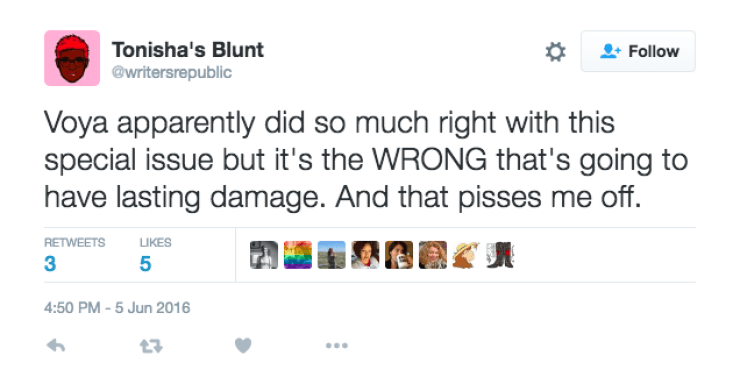
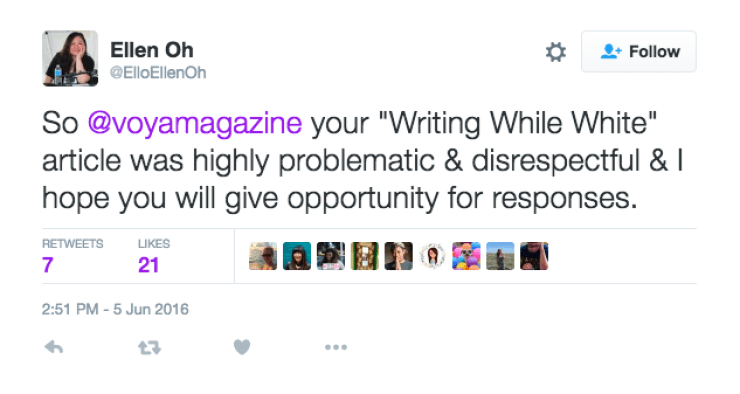
I have a really hard time with this type of response to criticism; it shows a remarkable lack of empathy from someone in a place of power. I hope that Honnold has since read the many, many responses on social media, such as:


screen-shot-2016-06-07-at-11-57-04-am.png

screen-shot-2016-06-07-at-11-47-15-am.png


So, Patrick and the VOYA editorial staff: are you listening? From one who played a part in this, I highly encourage you to open yourself up to the criticism that is rightfully coming your way, and own up to your mistakes.


Sincerely,

Sam Bloom

Friday, June 10, 2016

Naming Names: Thunder Boy Jr.

I appreciated Thunder Boy Jr. by Sherman Alexie from my first read of it earlier this year. It made me laugh out loud even as I felt buoyed by the meaning this story would undoubtedly have for many children, but especially Native children.
I also appreciated the review of Thunder Boy Jr. by Debbie Reese on the American Indians in Children’s Literature (AICL) blog.  It made me stop and think, and it helped me further my understanding of the broader contexts in which Thunder Boy Jr. exists and is shared.
I like the book. I like the review. These two things are not mutually exclusive.
Reading Thunder Boy Jr. is such a delight. It’s a well-crafted narrative with a distinct, childlike, emotionally honest voice, and full of good-hearted humor, all set against illustrations by Yuyi Morales that are playful, warm, and full of surprises.
In her AICL review, Debbie Reese writes:
Alexie's much-loved humor is front and center of this story. Because Thunder Boy's dad is a big man, his nickname is Big Thunder. The words "Big Thunder" are extra large and bold on the page, inviting readers to boom it out as they read it. That makes it all the more inviting as a read aloud. If his dad is Big Thunder, that means Thunder Boy's nickname is Little Thunder, and that is not ok with him:


“That nickname makes me sound like a burp or a fart.”
… I look at the illustration of the two kids [Thunder Boy and his little sister] and my heart goes right to my sister's grandchildren and memories of them playing and dancing together at my niece's wedding last week. I think they'll like this book very much.
The review expresses appreciation for the book, but also asks questions about whether the fact that the author is Native (Alexie is Spokane) makes the fact that he has written what she also sees as a “Pan Indian” story alright. She states she doesn’t have an answer to that question.
I confess this was my introduction to the term “Pan Indian.”  I realized it refers to a lack of cultural specificity that implies there is universal Indian identity rather than many distinct Native cultures. Now I have the term to name what I’ve so often seen and described to teachers and librarians when talking about evaluating books about Native peoples critically.
I had not considered Thunder Boy Jr. in this context, because I knew Alexie is Spokane.  But nowhere in the picture book text itself or in an author’s note, the review points out, are Thunder Boy and his family (or Alexie himself) identified as being Spokane.
In a follow-up post to her review, Debbie Reese writes about why she thinks Thunder Boy Jr. needs a note to readers—one that identifies the story’s cultural specificity and even provides specific information on Spokane naming traditions. She leads with an anecdote about someone on Twitter who wrote about having kids pick new names after reading the book, and then shares a worksheet her cousin’s child brought home from school last year—a worksheet in which the children were given information reinforcing broad stereotypes about Native peoples and their names before being invited to choose their own names.


The underlying implication and takeaway of the worksheet, and, she’s concerned, of Thunder Boy Jr., for non-Natives is that all Native peoples and their naming traditions are the same. She notes that naming traditions are culturally specific, and for some cultures like her Pueblo one, names are conferred in private ceremonies. Activities like the worksheet her cousin’s son brought home not only strip Native cultures of their individual identities, but they reinforce stereotype after stereotype, along with decades if not centuries of cultural appropriation.
As I've noted, 100,000 copies of the book were published. I'm hoping that Little, Brown (the publisher) will include a Note in the next batch, providing a "do not use this book as an activity for which kids pick a Native American name," an explanation for why that is not a respectful activity, and a bit of information about Native naming. If you've got a copy, or if you get one of the 100,000 copies, I hope the information I share here is helpful


Inevitable: Tweet from someone who read Alexie's Thunder Boy Jr. to kids and then did activity where kids picked their Indian names.


Fact: Imagine being a Native kid in that class, who already has a name, given to them in ceremony, being asked to make up a new one.


Question: Would it help adult readers NOT do that activity if there was a note inside the book about Native peoples and naming?


A truth: A white teacher asking a Native kid to choose a new name harkens back to boarding schools where teachers asked Native kids to point to a blackboard to choose a new name.
I found myself thinking a lot about Thunder Boy Jr. and the broader context—the wider world—into which not books but children live and breathe and, we hope, thrive after reading Debbie Reese’s review and follow-up post. What she wrote didn’t change my appreciation for Alexie’s wonderful story, which it’s clear she also values. But it did expand my understanding and, I hope, critical thinking. Her willingness to ask questions that don’t have clear answers, and to share her perspective as it unfolds, and to teach as well as critique, is not only risky, but as remarkable in its own way as the lovely, lively, meaningful picture book about which she was writing.

Monday, May 23, 2016

What to do when "nonfiction" centers Whiteness?


The other day, I came across a copy of The House That George Built (by Suzanne Slade, illustrated by Rebecca Bond, Charlesbridge, 2012).


A play on The House That Jack Built, the book features a sing-songy rhyme on the righthand side of each spread (“This is the lot / that grand, scenic spot, / for the President’s House that George built”) and a more detailed history of the President’s house’s conception, building, and completion on the left. Painterly watercolors add to the book’s storybook-like feel.

Not until more than halfway through does the book acknowledge that our White “Founding Fathers”--the ones who fought so gallantly for freedom--enslaved other human beings to create the President’s House. And even that information is couched in bowdlerizing language: “By now over one hundred workers--free men and slaves--lived on the construction site in small, temporary huts. They labored from sunrise till sunset, six long days a week. But with presidential duties and the house, George worked seven.” In the Author’s Note, the topic of enslaved people’s labor on the President’s House is similarly relegated to a small paragraph towards the end. That’s it.

I am accustomed to prettified versions of America’s history, but I lingered over this one (which somehow never showed up on my radar screen back in 2012). Here’s why: I cannot mentally square the care and precision the creators took to call the building the “President’s House” rather than the “White House” (it was not called “the White House” until the early 1900s) with the revisionist decision they made to frame the book around the idea that “George built” it.

Why so careful to get the building’s name right, but so free to credit a slaver with having built it, when the only actual building that George participated in was pounding in some wooden stakes to mark the site?

Accuracy is a big deal in anything labeled nonfiction. I’ve been on enough award committees to know that even the slightest error can doom a book. The author and editor were probably hyper-aware of this as they made the decision to consistently call the building the “President’s House”. But what to do when accuracy isn’t the issue so much as White-centricity? I can already hear the denizens of George-defenders telling me “but it was his project! He envisioned the house, that’s what the authors meant, it’s supposed to be a metaphor! Anyways, you have to consider the time--slavery was legal!” OK, I get all that. And, I also get that George’s point of view isn’t the only point of view from which we can look at this story. Where’s The House That WE Built, told from the point of views of the enslaved Black people, free Black people, and immigrants who actually built the thing?

I do see some promising signs of change. More and more reviewers are naming a White-dominant narrative as a problem (Kirkus being a prime example), but we also need authors and editors to consider whether their narratives--particularly their “nonfiction” narratives--are White-centric.

Consider, for example, Bold Riders: The Story of the Pony Express (by John Micklos, Capstone, 2015).


Over and over, this pithy book presents First/Native Nations people as one of a series of obstacles the brave Pony Express riders needed to surmount:

“The route crossed mountains, rivers, and deserts. Winter snowstorms and spring floods might prevent delivery. Riders also needed to cross land claimed by many American Indian tribes. Some of these tribes were warlike. How could lone riders get through?” (p. 13)

“Riders spent long hours in the saddle and faced many dangers. They might get trampled by a herd of stampeding bison. They might have to outrun hostile American Indians. Even if all went smoothly, they finished their shifts stiff and sore from their hard rides.” (p. 19)

“The brave Pony Express riders had many adventures and faced many dangers. History shows that the Paiutes were at war with settlers and soldiers along the Pony Express route. When riders said they had tangled with or escaped hostile Paiutes, they were likely telling the truth. Sometimes they even had scars to show. We also know that some riders lost their lives in the line of duty.” (p. 20)

The p. 20 quote, in particular, intrigues and troubles me. Micklos seems to know that something in this narrative is “off”, and is defending his White-centric narrative with “these are FACTS.” But that’s a strawman argument. I don’t think anyone would dispute that Paiute people fought White Pony Express riders.

The problem is the way the narrative is framed and constructed in the first place. Why were the Paiute people attacking?  Were they, in fact, attacking--or defending themselves?  Page 13 refers to land “claimed by many American Indian tribes,” but if the First/Native Nations people were there first, wouldn’t it be more accurate to say that the White people “claimed” that land? Why are the First/Native Nations people described as “hostile” and “warlike”, while the White people are described as “soldiers”? Why, for that matter, don’t we use the term “invaders” instead of “riders”? Where are the narratives that are just as by-the-numbers accurate, but centered in non-White points of view?

Don Tate’s Poet comes to mind, as does 1621: A New Look At Thanksgiving, and for teens, Howard Zinn’s Young People’s History. I’d love more. Leave them in the comments (and publishers, feel free to send us more of the real thing!).


Ed. 6/19/2016: Alyssa Mito Pusey, Senior Editor at Charlesbridge and Editor of The House That George Builtresponds via CBC Diversity.  In her post, Alyssa models what a productive, constructive dialogue can look like, and also bravely shares her own feelings:

For me, it’s a nerve-racking time, in some ways. Authors and editors are being held to more rigorous standards, and I really don’t want to mess up. I certainly don’t want to incur the wrath of the blogosphere. More importantly, I don’t want to produce books that perpetuate racial stereotypes and white privilege, however unintentionally.

My fears aside, this is also an exciting and empowering time. I feel like my eyes are being opened, like I’m learning and growing with every article and blog post—Allie’s included. I’m receiving and acquiring more biographies of people of color. I’m asking experts and other readers for honest feedback on questions of representation. And I’m trying with every book to be as inclusive as possible.

I’ve got a long way to go, clearly. But I hope to keep on improving as an editor—and to do what I can to help publish nonfiction that accurately reflects our diverse world.

Alyssa, a huge thank THANK YOU goes out to you from me and the whole RWW team.  I particularly admire how you make space for your own fears as well as the excitement and empowerment you're feeling, and how you phrase this as a "yes, and" rather than a "yes, but"--you're excited AND afraid, not excited BUT afraid.  This is a crucial distinction, and something I, as a white person, need to practice, as this type of thinking runs counter to white culture.  Again, thank you.

Wednesday, May 18, 2016

BEA Round-up, Housekeeping, and some links

Image by Lisa Nowlain
With today’s post you get a twofer: first, a brief recap of School Library Journal’s (SLJ's) Day of Dialogue; second, some housekeeping reminders and links.
I traveled to Chicago for BookExpo America (BEA) last week. One of the main reasons I went was SLJ’s Day of Dialogue on Wednesday. Check the link and you’ll see why; it was an amazing line-up of book people. But as wonderful as those authors and illustrators were (and are), the panels were overwhelmingly White. Yes, there was at least one person of color on each panel, but 20% (or less) representation isn’t enough. And the fact that there was not a single First/Native Nations panelist is unacceptable. Plus, the two keynote speakers and all four moderators were—you guessed it—White. Now, I’m honestly not sure how much of this is on SLJ and how much is dictated by the publishers, but I’m assuming that SLJ will work to do better if they have anything to say about it based on their commitment to cultural competency in their reviews.
Now, on to the housekeeping. It’s been a while since we’ve highlighted our supporting documents, all of which can be found directly underneath our banner. Don’t forget to look at our FAQs; we’ve added a few things since our inception. We get questions sometimes about our comment policy, so check that out too. And finally, don’t forget to visit the blogs in the Kindred Spirits section as often as you can!


Here are some links from the last few weeks:

Latinxs in KidLit: a history of the Belpre (first in a proposed series; also, check Latinxs in KidLit for features on winning Belpre authors/illustrators)

Debbie Reese has written a series of posts on Thunder Boy Jr., the new picture book debut from National Book Award winner Sherman Alexie (illustrated by Caldecott Honoree and many time-Pura Belpre winner Yuyi Morales):
Part 1
Part 2
Part 3
Have you been watching the #WhitewashedOUT hashtag on Twitter this month? This link will give you a bit of background on the situation, spurred on by so many appalling Hollywood casting decisions. A related hashtag to follow: #StarringJohnCho, which imagines the Harold and Kumar star in big Hollywood roles played by White male actors. Good stuff there.

Finally, from the NCTE blog: “In my own work with Black high school writers, I want my students to see not only themselves in what we are reading, but I want them to recognize their own capacity to be writers and thinkers.” - Latrice Johnson

Tuesday, May 10, 2016

Free Choice Reading & Tokenism

Being in a public library, at this time of year all I can think is “summer reading,” and I know that for many it is the same.   Kids need to read during the summer; kids read when it’s fun; it’s fun when they get to choose their own reading.  


But choosing their own reading really means just that; if a grownup is suggesting a book, it’s almost automatically tainted. So having a selection of books that kids can choose from is key.   Ergo: summer reading lists.


What is in your summer reading list? Do you have one, or use one? What kind of choice does it offer readers?


Last year Edith Campbell assembled a group of colleagues to create the We’re the People summer reading list.  Now in its second year, it gently suggests at the top of the website that you use it to “add to your summer reading list” books that are written, illustrated, and about people of color or First Nations/Native Americans.   However, I think it functions beautifully as a stand alone summer reading list in its entirety, and calls attention to the a “one of each” token representation that sadly still exists in many book lists out there.


The title of this list recalls for me the National Endowment for the Humanities (NEH)’s “We the People” Bookshelves that were promoted 2003-2011.  The program awarded sets of selected titles to public and school libraries; each year’s “classic” book collection was related to “a theme important to the nation's heritage. ...In addition to introducing young readers to good literature, the Bookshelf promotes understanding of abstract or general ideas through the power of particular stories.”  The first year’s list, on Courage, included Little House on the Prairie and The Matchlock Gun.  Debbie Reese posted a wonderful letter by Jean Mendoza in 2007 about continuing concerns with these booklists, asking that the “We the People” Bookshelf “get in synchrony with reality.”  Some of the final lists in the project showed slight improvement.


Besides summer reading lists, many libraries offer free books in the summer, as outreach or incentive for summer reading programs.  My library offers a giveaway book as the prize to approximately 6000 children who read at least 20 days in the summer.  Buying enough paperbacks that will offer the right selection to any kid who stops in one of our 17 libraries is a challenge; we want to make sure that when they browse the prize bin, they feel they are being awarded a prize.   We buy most of these books from Scholastic’s Literacy Partnerships, the arm of the publishing giant through which providers who are giving away books to children can buy very cheap paperbacks.  Scholastic has always offered titles to serve a diverse community, though I still wince when I must seek out the word “multicultural” in the curated sets, and dodge over-used standards and problematic titles.  We don’t rely on Scholastic, as it also does not fully meet our demand for popular non-fiction and graphic novels.  At the same time that I sense its selection is improving, we continue to advocate for and secure funding to raise our price point per giveaway paperback, so that we can shift more of our purchases to other vendors.

In its related arm Scholastic Reading Club (through which kids can purchase inexpensive paperbacks through their classroom), Scholastic’s We Have Diverse Books partnership with We Need Diverse Books resulted in a “Special Collection of More than 75 Diversity-Themed Books for Children” list, and there are plans for 8 such lists in the 2016-17 year.  It’s progress, I guess.  Still, I yearn for kids to have the choice wherever they look for a selection of recommended books that will inspire them to read for themselves, for fun, without having to seek the “special” section.