Sunday, August 14, 2016

Interview: Renée Watson talks Langston Hughes, I, Too, Arts Collective, gentrification, and more.

http://static1.squarespace.com/static/53826245e4b07bcdae10741b/t/53adc901e4b02da6391e2807/1403898117019/27ef868543abf9c4e16439c1aeb8f0bd.jpg
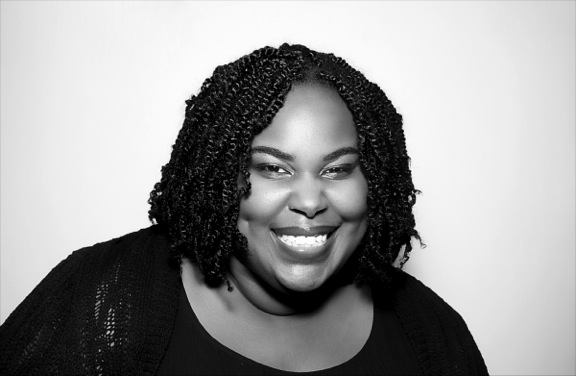
Author and I, Too, Arts Collective Founder Renée Watson


Reading While White is delighted to be joined by Renée Watson, founder of I, Too, Arts Collective, today.  Below, RWW team member Allie Jane Bruce interviews Renée.


Allie: Congratulations on launching this initiative!  How did it happen?  Did you just pick up the phone one day and say to the owner, "I want to turn this brownstone into a space for poets”?


Renée: Believe it or not, it really did happen that way. Only before the phone call, I had been thinking about how I really wanted to see that space used for something meaningful in the community.

I have been thinking this for many years now and the more Harlem changes, the more urgency I felt to do something. So before making the phone call, I had a proposal together and had thought out a whole businesses plan—you know, the practical stuff.


Once I shared my vision with the person who owns it, she was very moved and agreed to give us till the end of August to raise money for the lease.


Did you and she talk about the gentrification happening in Harlem?  Is that a motivating force for both of you?


Yes, we’ve talked a lot about gentrification and our hope to preserve this space instead of seeing it become overpriced condos.


For me, gentrification is very complicated. I appreciate not having to go across town to get healthy food options, I’m the first person in line for a good brunch, and as a writer I spend a lot of time in coffee shops working.  I enjoy shopping at trendy stores but I am not for erasing a people’s history, pushing them out so that they can’t afford to live in their neighborhood, their home. This is one of the reasons why I started I, Too, Arts Collective.
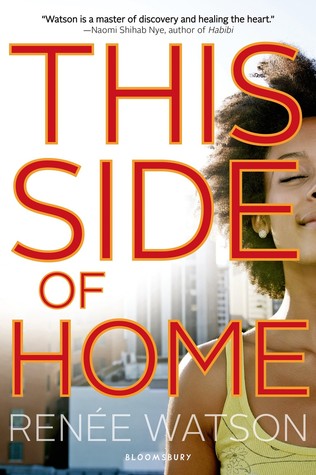
Watson's YA novel This Side of Home
is about twins who have different
reactions to the gentrification impacting
their Portland neighborhood.

As I’ve toured the nation on a book tour sharing This Side of Home with young people, I’ve heard countless stories of communities being dismantled, of local and cultural histories being erased. I hope that restoring Langston’s home can be a way of reclaiming space, a way to ensure that Harlem’s literary history—Black literary history—will be preserved.


So, yes, it is about standing up against gentrification. But my other motivation is about providing a space for people of color and people from marginalized communities to have a haven to create and tell their stories. Our stories matter and so many people try to speak for us, try to come in and “give us a voice."  I, Too, Arts Collective is not about giving a voice but providing a space for young and emerging artists, as well as professional artists, to share and develop the artistic voice they already have. To put on record for themselves where they come from. Inspired by Langston’s body of work, we hope to encourage people to not shy away from the pain or only write about the joy, but to create art in response to it all.


When I read Langston Hughes, I'm struck by how much of the social issues present in his work are front and center in the USA today.   I'm thinking especially of his (out of print) book Black Misery, which was from a child’s point of view.  For example:
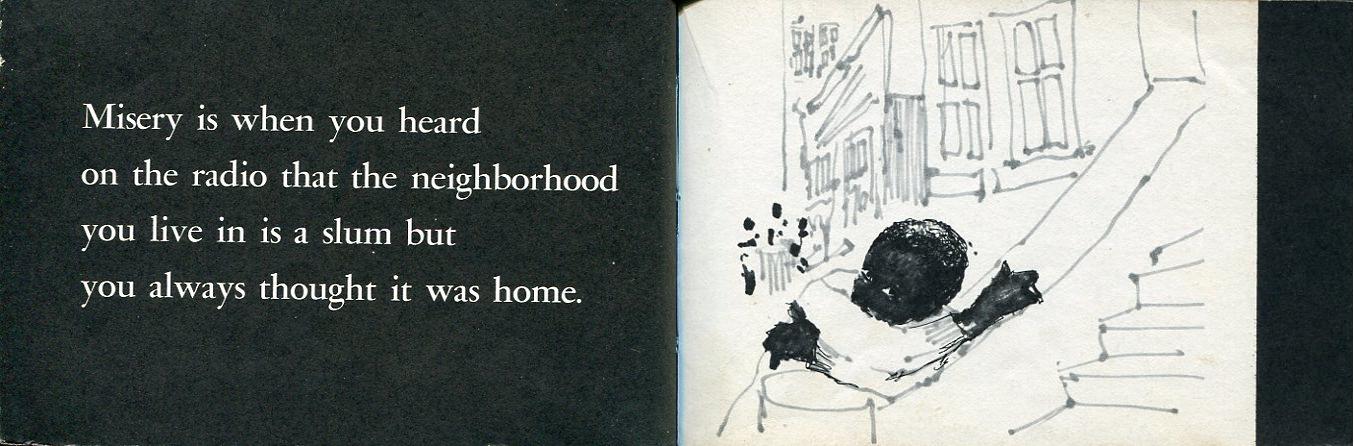

"Misery is when you heard / on the radio that the neighborhood / you live in is a slum but / you always thought it was home."

And also: "Misery is when you start to help an old white lady across the street and she thinks you're trying to snatch her purse" and "Misery is when the taxi cab won't stop for your mother and she says a bad word."


What do you think Langston Hughes would be writing about today, if he were alive?


I think he'd be writing the same kind of poems he wrote back then—poems about Black lives and how they matter. Poems that humanize otherness. I have been reading his poems, as well as poems by Lucille Clifton a lot lately. They are keeping my spirit intact, keeping me from wallowing in sorrow and frustration. There is sadness in their work, yes, but there is also an unapologetic pride and joy there too. There’s a truth telling, a rebuking, an honoring, and a love that Langston writes with. When I teach him in the classroom, I ask young people to think about how they can also be recorders, responders, rebukers, rejoicers and rebuilders of their world through art. I encourage them to compare and contrast the times we are in now and the times that Langston lived through—what’s changed, what’s the same? How far have we come, what more do we need to do?


I love how you crystalize these ideas: "to compare and contrast the times we are in now and the times that Langston lived through—what’s changed, what’s the same? How far have we come, what more do we need to do?" Will you make it an explicit part of your goal at I, Too, Arts Collective to feature poets who are "recorders, responders, rebukers, rejoicers and rebuilders" pondering these questions?


Absolutely. Our summer intensive program will be a social justice and art program. Participants will create art (writing, visual, and performance pieces) in response to a social issue they care about.


This is not to say that we won’t also teach the craft of writing poetry. I think it’s important that both craft and social awareness are nurtured. I want our young people to create from a place of passion and skill. I also believe that besides the artistic and creative component of our workshops, we are building world citizens of the 21st century. The need for critical thinking skills and empathy are crucial. Through art making, I believe young  people can develop and practice life skills that will help to create the world in which we want to live. So even if our young people never become professional artists, the life skills that the arts impart and cultivate, to me, are just as important. I say this often, but I really do believe that artists are problem solvers—we understand what it means to revise, to start over even. With each project we work the muscle of perseverance and commit to seeing something until the end. This means that every artist knows that change is sometimes slow. That progress needs to be revisited, reassessed. That there is always work that can be done. In our workshops, we’ll talk explicitly about this relationship between our art making and our activism.


Before moving on—I want to stress that I do intend for the space to be fun and full of laughter. Sometimes when we talk about social justice and art, it takes on a heaviness. And yes, there is a time to think critically and challenge the system.


There is also a time to celebrate and honor unsung heroes, to reflect on what’s beautiful, what’s worthy of praise. That’s what I love about Langston’s body of work. It is not hopeless even though it speaks of struggle. There’s joy there, there’s an intentional and calculated hope. That, too, is the legacy we want to continue.


How can people support I, Too, Arts Collective?


We’ve launched a fundraising campaign and I’d like to invite people to get involved by giving what they can. We’re accepting donations starting at $5+ and there’s a variety of perks when you give. You can check out our campaign page here and see our launch video below.


Another way to support us is to spread the word and keep up with our progress by following the hashtag #LangstonsLegacy or following us on Twitter: @ITooArts


Renée, thank you so much for launching this project, and for taking the time to talk with us!


Wednesday, August 10, 2016

So You Bought A Racist Book For Your Library: Now What?

My library still has Little House on the Prairie. Several copies, in fact.


We have them even though I know how racist and inaccurate they are. And I still buy new copies when the old ones wear out.  I bet it’s the same at your library.  These are part of the compromises we make when we work in libraries.  Often in online discussions, you’ll hear some librarians or authors make it seem like if you recognize racist and problematic content in books you must be the kind of librarian who pulls those titles from your shelves and tears them up in front of your patrons.  But there’s so much more nuance in these situations and that, of course, makes them difficult. Librarian's reactions to the Little House range from  wanting to remove them to finding ways to teach with them.  


Even though my library has several copies of Little House on the Prairie we also have several copies of The Birchbark House by Louise Erdrich. I often get to share with people checking out Little House my love for Birchbark and how I think they make wonderful companion reads. More than once I have seen parents and kids head back to the shelves and check out The Birchbark House to go along with Little House.  Is this a perfect solution?  Of course not.  But it’s a direct one with often immediate results.  It’s the kind of solution I don’t think I’ve ever heard from the crowd of naysayers who chime in with “Wow, when did we get so POLITICALLY CORRECT!” and “Wow, I guess you don’t believe in intellectual freedom!” in online discussions, blog comments, and sometimes even in person at conferences and workshops.


I have been reminded of this example and these encounters time and again as people brought up justified concerns about books from A Fine Dessert to the more recent When We Was Fierce. I have seen many librarians who were unaware of the problematic content of these titles who now find themselves at a loss for what to do now that these books are on their shelves.  Many librarians pre-ordered When We Was Fierce based on the starred reviews it received from three major publications.  As of this writing, Candlewick has put the book on hold, so that e. E. Charlton-Trujillo could “allow herself a further review of the text.” But many librarians already ordered it.  The question I’ve heard over and over is “I’ve got this thing, now what?”


Megan did an amazing job writing about accusations of censorship in a library setting and I urge all librarians wrestling with this question to take the time to read it and consider how it applies to their library and their collection development. Like Megan, I am not giving you prescriptive advice on, “Do this or else you’re a bad librarian!” But I think there are some issues here worth taking a deeper, more considerate look at.  


First: if you did, in fact, pre-order When We Was Fierce I ask you to really ask yourself why.  Did you just look at three starred reviews and then look no farther? Did none of the sampled dialogue in the reviews make you somewhat wary?  The Publishers Weekly review quotes this dialogue: “Jive brothers rolled in hard./ They walked intent.... I didn't want nuthin' to do with their truth.” Jive brothers? Nuthin’? Does that sound to you like the way contemporary African-American teens talk?  Honestly? The Kirkus review quotes these phrases: "He wanna have speak" and "We all held our wait." When I read those reviews a bell in the back of my head instantly started ringing.  It sounded, to me, like a Saturday Night Live sketch - the imagined and deliberately simplistic way someone who is not familiar with it might think African-American Vernacular English (AAVE) sounds.
Read the reviews for When We Was Fierce closer.  There are more warning signs.  In Booklist’s starred review there is an allusion made to the “semi-invented vernacular” but there is no deeper look at what that means. When I read that I wondered: “Why does the author feel a need to invent a vernacular when AAVE already exists?  Is it because the author can’t actually converse in AAVE and doesn’t understand code-switching while using it?” (Edith Campbell touches on code-switching and how it relates to this book in her review.) These were warning signs to me.  


What else was troubling? This line from Kirkus’s review: “Only the free verse's frequent apostrophes connoting a dropped letter are stereotypical and distancing.”  How could someone write this, I wondered, and still give the book a positive review?  How could Kirkus still star this book? If you read a professional review, even one that is starred, even one that is overall positive, and it mentions something is both “frequent” and “stereotypical and distancing” that should give you at least a moment or two of pause when it comes to purchasing.  Do you have the money in your budget and the room on your shelves for a book with a flaw that major?  


What To Do First


So the first thing we can do, as purchasers and librarians who work in collection development, is be more deliberate and wary when we read reviews. Often, we are asked to just look at the stars or even gloss over the content of the reviews. Who has the time to read ALL the reviews?  I know our time is at a premium - I do collection development too and am a final selector - but it’s important, it’s necessary to be critical even of sources that are supposed to be critical themselves. This takes time and it is on us.  And it’s worth it. Ask yourself hard questions: Does this sound true?  Does this sound complete? What biases do these sources bring to this review?  What knowledge or experience is lacking from it? That onus IS on us; that IS what curating a collection deliberately and thoughtfully means.


But what if you did order When We Was Fierce (or A Birthday Cake for George Washington, which actually had negative professional reviews so you were given some warning before ordering) and it’s been shipped and processed and is on your library shelves as you read this? I can’t tell you if you should pull it from your shelves or not.  That’s a decision you have to make based on reviewing the material yourself and your own collection development policies.  I would ask, however, that in both the case of When We Was Fierce and A Birthday Cake for George Washington you consider that the publishers have said these books are not ready to be sold.  That is not insignificant.  I would also urge you to take some time and actually review the material yourself - not just rely on the reviews (negative or positive) - and then think about how your patrons might react and interact with such work and about what messages that sends them about the library as a welcoming place for all. Once you have looked at it, read it yourself with a truly critical eye, listened to the voices of people like Jenn Baker and Edith Campbell and Zetta Elliott and Ibi Zoboi and Kwame Alexander: would you still purchase it? If the answer to that is no - if the answer to that is no and you know that the publisher and the author have chosen to postpone the book so it isn’t released in the form you have then yes, that might be a legitimate reason for you to withdraw it.  


As you consider When We Was Fierce on your shelves, I also ask you to think of the Publishers Weekly review that says it “gives voice to the unheard.” Why that line?  Because it is so very, very wrong.  It is wrong to assume that this book is an authentic representation of the voices of African-American teens.  And it is wrong to assume these voices are not part of YA and children’s lit - they are and always have been.  While these voices might be marginalized within YA and children’s lit it is on us, as educators and librarians, to change that. And we can.  We can do it up spotlighting and booktalking and putting face out on our shelves the books that have authentic and humane diverse voices and experiences.  Are these voices “unheard” because they don’t exist or because the majority culture simply refuses to listen?


You can show you are listening by making sure your collection has more than just When We Was Fierce or Little House on the Prairie.  And be ready to booktalk those titles and promote them to your patrons. We can listen and we can push forward with truth. That’s what you can do now and always.


SOME SUGGESTED TITLES TO BALANCE YOUR COLLECTION


He Said, She Said by Kwame Alexander


Tyrell, Bronxwood, and Kendra by Coe Booth


A Wish Before Midnight and The Door at the Crossroads by Zetta Elliott


See No Color by Shannon Gibney


How It Went Down by Kekla Magoon


Shadowshaper by Daniel José Older


Show and Prove by Sofia Quintero


The Boy in the Black Suit by Jason Reynolds (everything by Jason Reynolds, to be honest.)


Jumped by Rita Williams-Garcia


After Tupac and D Foster and Miracle’s Boys by Jacqueline Woodson

Literally anything Walter Dean Myers wrote, I mean. Come on.

Monday, August 8, 2016

Feedback Over Fear

Elisa Gall
We are thrilled to welcome another member to the Reading While White team. Elisa Gall, an  insightful reviewer and reflective critical thinker, works as a school librarian in Chicago.  Her first post is below. Welcome, Elisa!


I was participating in a diversity workshop a few months ago when a person of color shared with our small learning group how most of his White friends consider themselves allies, but if you ask him which of those friends he thinks act as allies, it would be maybe one or two of them—and not all the time. The moral of the story (from his perspective) was for me to learn to do the best anti-racism work I can. Let others decide how I do in each moment—and focus my time on productive action. I won’t always be an ally to everyone. I will make mistakes. It’s not an either/or. I can even do important work and mess up at the same time. What matters is how I listen and learn in these instances, and how I keep going after I experience them.

When I was first asked to join the bloggers at Reading While White, my first reaction was deep feelings of inadequacy. Who am I to do this writing? I am still learning. I’m going to be exposed for my implicit bias and embarrass the hell out of myself!

As much as I do to work towards awareness for myself and other White people like me, I know that I have unconscious biases of which I am not yet aware. I sometimes feel frozen by shock or fear. I hesitate to chime in because I don’t want to be silent in the presence of injustice, but I also want to amplify voices instead of taking up space or speaking over someone else. I have to constantly check myself: WHY am I doing this? Writing this? Saying this? Feeling this? This is not about hating White people or having a negative racial identity. It is about working to interrupt racism and being open to giving and receiving all kinds of feedback. At times, I have seen myself unfortunately uphold what Robin DiAngelo refers to as the “White Rules of Engagement.” The idea of learning and sharing so publicly on this blog does make me uncomfortable, but I acknowledge that private conversations and indirect feedback only work to keep the structure of racism alive and invisible.

At the White Privilege Conference in Philadelphia last spring, speaker Vernā Myers said to the crowd, “This is not the time to be afraid to say the wrong thing. We can’t afford to be stuck in shame, blame, and guilt.” She challenged the audience to reflect: Will I believe what others say about their experiences? Do I know when I am wrong? When I don’t know, do I pretend I know? Do I use my mistakes as an excuse to not engage? She added, “This isn’t about perfection. It is about connection.” Embracing imperfection leads to more gains than losses. In Promoting Diversity and Social Justice, Diane Goodman wrote about all the upsides when people share this mindset: more knowledge, new information, better understandings, heightened awareness of self and others, and authenticity—for people are less guarded, more spontaneous in interactions, and can find greater compassion for each other.

I believe that if I am not trying to combat a system of injustice, I am perpetuating it.  But I must remember (to again paraphrase DiAngelo) that I am colluding with racism when I try to be a perfect White anti-racist. I needn’t try to be perfect. I need to be humble. I need to be growth-mindset oriented. I need to be strong, and compassionate, and reflective, and a good listener. Feedback is difficult, but it is vital. I am going to embrace it on both the giving and receiving ends. I appreciate the opportunity to be involved in all of the learning that happens here through this blog. I look forward to working towards increased accountability, for others and myself.

Wednesday, August 3, 2016

Nice and Neutral

School Library Journal (SLJ)’s online news service recently offered a curious round-up of the There is a Tribe of Kids discussion. The article depicts an un-nuanced controversy with two sides, perpetuated by “Some” and “Others.” “Some” purchase the book, and are represented in the article by a librarian who decided not to renew her ALA membership after witnessing attacks, some directed at her, on the ALSC listserv. “Others” are represented first and foremost by Debbie Reese, voicing objections to the book.  


When I read these listserv comments, I do not see the voicing of objections as the “personal attacks” that others have perceived.  It concerns me to hear of fear of speaking out because of a perception of aggressiveness of “one-side” or “a few,” phrases I find frequently used to marginalize a variety of dissenting views.  Those expressing fear of attack or shaming have called on everyone to be “respectful” and “kind,” as if these concerns are somehow less valid because they aren’t being expressed in a way that makes everyone feel nice.  They have also expressed frustration that public libraries “no longer represent neutrality.”


The problem is that the “neutrality” of libraries does not exist.  Storytime Underground has recently demonstrated this, and #Libraries4BlackLives further explodes the neutrality myth.  What does exist is a status quo which, to protect its existence, parades as neutrality.  For libraries to fulfill their role as a place for free exploration of ideas and diversity of thought, to actually “provide materials and information presenting all points of view on current and historical issues”  we must have those materials.  But we don’t have those materials because publishing is a market-driven industry.  If we don’t make the industry listen to and respond to all voices, not just the status quo, we will never have libraries that serve all in the community.  It is clear, for instance by listening to these teenagers of the Unitah and Oorah Nation, that the saturation of stereotypes about people of color and First Nations/Native people in our media today still promulgate racism, in this case, by the sheer preponderance of images or literary examples of non-Native people dressing like Indians. In this video Lavin says: “When you search up “Native Culture”, you’ll see people...you’ll see Whites….I’m not trying to offend anyone here...you’ll see Whites...well, it is kind of offensive to us...you’ll see Whites dressed up as Natives, you’ll see them in headdresses, when headdresses are like the holiest thing, to represent us as higher people. … It makes me so mad.”


What I have seen in the discussion of THERE IS A TRIBE OF KIDS is an invitation to think deeply and explore different points of view, a place where professionals can seek to make informed decisions about how and where and whether to use this one particular book, among many, and also send a message to book creators and publishers about what gaps and pitfalls in children’s literature this book exposes, so that they can better create books that will help us do our jobs. Yet, comments on the SLJ Facebook post for their article included responses along these lines:


“I think people need to relax a bit”
“This PC nonsense has gone too far”
“No matter what we write or say, people in the other end will find objection. Silly!!!!”


These are common defensive reactions to critical exposure of the status quo, typifying criticism as one side crossing a line (an attack), or just baseless (silly nonsense).


If a person chooses to believe that what they know is the only truth, then a challenge to that knowledge will feel like an attack, because this person has nothing else to stand on.  This person feels they are confronted with a battlefield to defend their truth, and will do what they can to dismantle the argument: cut it at its knees, call in the troops, or refuse to engage.


If one can see one’s own knowledge as a piece of the truth, then one can enter a field of discussion without fear, trusting that there is more to know.  Venturing into that field, seeing more, and then looking back at my own truth, I’ve seen it behave in a myriad of ways.  Sometimes, it fades or flutters away: still itself but less significant, in the scheme of things.  Sometimes, I see it still there, solid, unchanged, but a piece of something bigger….the tooth that thought it was the whole jaw. Sometimes, it stands obstinately, but I see it standing on top of an enormous lie, and I choose to turn my back on it.  And sometimes...I decide I’m just still right.  But where my Whiteness is at play, that has not generally been the result.

I expect that some colleagues will continue to stop engaging, feeling that what was a “nice” safe space for them is changing. But it was never nice, and it was never safe, except for those whose interests are served by the status quo. Our colleagues from marginalized communities have so much more at stake in these discussions than does someone like me, and the only attacks that I’ve witnessed have been the tone-policing of these voices. Like Lavin, people from marginalized communities have the right to be angry.  Expressing that anger when speaking one’s truth, so that others can learn, does not constitute an attack. As Dr. Ebony Elizabeth Thomas says, “Our critiques being mischaracterized as more harmful and unethical than the books themselves signals a total lack of willingness to listen.” These critiques are an invitation, and a challenge, to listen and participate in change that will further equity in our communities, through books for children, through education, through libraries. Come onto the field: the library is open.

Thursday, July 28, 2016

The Rocky Unpaved Roads of Good Intentions

          by Ibi Zoboi
               7.27.16


I write for children. I have the very best of intentions. This is a dream career and one that relies on altruism, empathy, love, and most important of all, respect. The same goes for parenting children. However, I am a smother. I have the very best of intentions to keep my children safe and arm them with the necessary tools to navigate life’s challenges. I am raising Black children. I have a tendency to hover, hug and squeeze for a moment too long, and shower them with wet kisses in public. But as they approach their teen and tween years, I have to step back and allow them room to breathe. The same goes for writing middle grade and young adult novels. I have to step back and allow the story, characters, and setting room to breathe. That book will go out into the world with wings of its own and fly, planting seeds in the hearts and minds of young readers along the way. And like parenting, this all begins with good intentions.

My children attend a wonderfully diverse progressive school where good intentions are woven into the fabric of the school community—from their social justice curriculum to their over-the-top parent involvement. The school has been lauded for their racial and socioeconomic diversity. However, the mostly white teaching staff and volunteering parents paint a different picture.

I am Haitian-American. I have family in Haiti who are often in need of money. Even in a country drowning in good intentions with its ten-thousand non-governmental organizations (NGOs) and constant stream of aid money, there are still those who have to rub two sticks together, as they say in Haiti, in order to make a buck. The shoe company, TOMS, launched an ad campaign last year where white twenty-somethings are shown frolicking through Haitian countrysides and beaches amongst laughing schoolchildren. THIS IS HAITI, they proclaimed.

My children’s school sounds like an ideal work environment for a young teacher of color—one that honors social justice work and educating the whole child. Yet, for whatever reason, the school seems to be in a perpetual cycle of “trying to find the right fit” when it comes to hiring teachers of color. And as for Haiti, there are Haitians who desperately want to work with these NGOs, not as noble artists in some equal exchange agreement, but as administrators with long-term contracts and housing benefits. However, as the TOMS ad suggests, humanitarian work is healing waters, warm island sunshine, and grateful, laughing children for outsiders only.

My husband, Mr. Z., is a public school teacher. He has good intentions as well. He has a deep well of patience, and goes above and beyond for his students, much like many of his colleagues. However, over the course of his twenty-year career, I've witnessed how time and time again, his deep connection with his students is sometimes seen as a threat. The evaluation often begins with, “You have a great rapport with the students, but…” As a Black male teacher, his good intentions come with risks. A recent Huffingtonpost video and article about his former school highlighted this dichotomy. A fellow art teacher, a white woman, was featured in the video, shedding a few tears and speaking of her love for her students and the many hardships in their lives. The video also showed glimpses of an art show that Mr. Z. helped to curate. Mr. Z. was not featured in the video. He could not have possibly shed a tear for his students and their hard lives, I suppose. In this case, someone else’s good intentions are held up as an example of excellent teaching, while Mr. Z.’s was simply “a good rapport, but…”.

This is the hierarchy of good intentions that reeks of White-Man’s-Burdenism. There is a self-perceived burden of doing something, making it right, and fixing things for the Other—that this Other cannot help themselves, even if this help comes from members of their own community.

Make no mistake, members of marginalized groups can also wear the cape of White-Man’s-Burdenism. In 2010, six months after the devastating Haitian earthquake, I launched a Kickstarter campaign to conduct a writing workshop for teen girls in Haiti. It was successful. I published a beautiful anthology of their poems. I reaped the rewards of my good intentions. However, toward the end of the workshops and my stay in Haiti, I had to step back and listen.

For many of the girls, it was not their first time participating in a writing workshop. Their schools have had poetry recitals and contests. Most importantly, those girls could not eat my good intentions. They could not use them to pay for school or uniforms or much-needed toiletries. I could not press cold-hard good intentions into their hands so they could go about living their lives after such tragedy. This workshop and resulting anthology was my own accomplishment. It was for my own healing and need to do something, anything. I felt duty-bound to give these girls a voice, but didn’t realize that they already had a voice. Their writing and thoughts exceeded my expectations. They didn’t need me to give them a voice. They had spoken loud and clear when I asked them what they wanted and needed: money and opportunities to make more money. My anthology and good intentions did not do that for them.

Recently, I spoke out online against this sort of well-meaning activism. Several fellow children’s writers participated in a Black Lives Matter initiative. Something didn’t sit right with me when I was asked to use the name of Alton Sterling, hours after his death, to offer critiques or ARCs of my novel in exchange for donating to the Sterling family or the Black Lives Matter movement. I had the visceral reaction that this was too raw, too soon. I asked that the founder consider removing the middleman and rewards, and have people donate to the family directly. As another fellow writer pointed out, it was a “mismatch of cause and activity.” But the initiative continued because, in this situation, direct action trumps mourning. The overwhelming need to “do something” supersedes quiet, reflective time to ask “wait, what is happening to us?” Good intentions outweighed perceived inactivity. 

With the recent criticism of e.E. Charlton-Trujillo’s When We Was Fierce, I couldn’t help but to wonder about this heavy burden of good intentions. When the discussion about the book was first brought up in a private Facebook group, I was at my agency’s retreat. Charlton-Trujillo was also there. I was one of two Black people at this retreat, and the only Black woman. My dear friends were very vocal about the problems in this book. And at times, I was within arms-length from the author. So we talked. I set the book and everything I’ve read about it aside to connect with the person away from screens and social media, to have a real heart to heart. The beautiful scenery and overall good vibes at the retreat begged for this sort of exchange.

After our conversation, I was reminded of the few times I had to approach some of my children’s teachers with, “I know you love your students, but this is problematic.” I truly cannot deny the author’s love, heart, and purity of intentions—it was all there. Having my children in progressive schools with mostly white teachers warrants that I rely on intuition—to feel a person out, connect with their heart, and gauge where their intentions may lie. And in most cases, this heart, these good intentions, are shrouded in White-Man-Burdenism—this need to save or help or give voice to without asking, “What is it that you want? What is it that you need from me, or how can I help you?”

I’ve learned this from my husband over the years. He’s realized that he’s a high school teacher, not a replacement father-figure to his students. He only listens without rushing to action, then asks, “What are YOU going to do about it?” or “What would YOU like me to do?” He empowers his students this way. He’s not there to save them from themselves. As an art teacher, he gives them supplies to create mirrors in the form of visual art. These mirrors are outlets and tools for self-expression. These mirrors are not windows into their hard lives for others to watch with pity. Their perceived pain and trauma is not fodder for guilt, thus fueling White-Man’s-Burdenism in the minds of voyeurs. Their art belongs to only them—however beautiful, disjointed, or painful.

I’m still learning how to do this as a writer for children. I have to shed the need to save, to write for, or to give voice to. The mirror needs to be held up to myself first. When I tell a story, I have to remind myself that this is about me and others like me first and foremost. I center my own experiences within the story, so that when it goes out into the world, I will personally connect with my readers, and they to me. Writing gives voice to the writer and no one else. The truth within the story will resonate with readers on its own. Problematic books written by outsiders are a mirror held up to that writer and the group she belongs to. The book says “This is what I think of you, or this is how I perceive you.” This voice, this perception does not belong to us. That is your voice as the writer. That is your truth, not ours.

Like the smothering parent that I am, every good intention needs to step back and check itself. Loosen that grip, let go of that need to save or protect or speak on behalf of, and ask instead, “What do YOU need?” or “What would YOU like me to do?” 

We need room to tell our own stories. Even if we hurt ourselves in the process with our own problematic content, we need breathing room to be reflective and unearth those deeply-planted seeds of colonization. We were taught to hate ourselves and everything about our traditions. Serving us more self-hate in the form of help, or placing warped, tainted lenses -- not mirrors -- before everyone’s eyes in the form of story, only deepens this wound. 

And like those teen girls in Haiti, we would like you to give us money (grants, scholarships, etc.), or create opportunities that will enable us to support ourselves and our families. Money and opportunities are tools for empowerment. Intend to empower us, level the playing field, cultivate true equity. Instead of writing our story, let us write it ourselves and get paid for it. Then we can begin to create self-sufficiency to rebuild our families and communities. Step aside and let us also stand at the helm of your non-profit organization or company whose mission it is to help or save us. Don’t stand on our backs and shoulders perpetually reaching down, offering to assist, while you remain standing on our backs and shoulders for all of eternity.

Most important of all, listen. Yes, to the help. Yes, to offering to assist and doing something so that there is a sea change. But when we say, “Ouch! That hurts,” or “We can do it ourselves,” step back and listen. Give us room to breathe.

Here are some bite-sized questions:

Before Writing the Other, ask yourself:
1) Is there another book like it written by a person from that community?
2) How can I center my own story and voice without appropriating another culture or community?

3) How can I discuss [insert issue here] through the lens of my own community?  


----
Ibi Zoboi holds an MFA in Writing for Children from the Vermont College of Fine Arts. Her debut young adult novel, American Street, will come out from Balzer + Bray / HarperCollins in February 2017, and a middle grade novel My Life As An Ice Cream Sandwich is forthcoming from Dutton Young Readers.