Monday, July 25, 2016

When Whiteness Dominates Reviews

by KT Horning


In the past twenty-four hours we've seen thoughtful critical reviews from Jennifer Baker and Edi Campbell about a new book coming out next week by e. E. Charlton-Trujillo, When We Was Fierce (Candlewick). Both reviews offer African-American perspectives on the book that contrast sharply with the praise it has received so far from White reviewers and librarians on social media. Why is it that Whiteness continues to dominate professional reviews? And what can be done to change that?

Last week I spoke to School Library Journal reviewers who were nearing the end of an eight-week course on Diversity and Cultural Literacy in Professional Reviews. The group had already heard from experts such as Debbie Reese, Angie Manfredi, Malinda Lo, Allie Jane Bruce, and Edi Campbell, and they had already done extensive reading and participated in online discussions with each other.


I think it’s great that Kiera Parrott and Shelley Diaz of SLJ are providing these kinds of opportunities for their team of volunteer reviewers. We need to see more positive steps forward in our profession for our reviewers and for people in our field at large. Because let’s face it, the majority of children’s book reviewers are White, as are most members of book evaluation and a award committees. Our experiences as White people are limited. How can we discern if a book about a child of color is authentic? In order to do our job, we have to seek out and listen to diverse voices. And those voices are not appearing much in the professional review journals.


A case in point: When We Was Fierce by e. E. Charlton-Trujillo. The book deals with a group of African-American teenage boys in the inner-city who get caught up in gang activity. I first became aware of this book when I started seeing the advance praise and reviews for it in the professional journals. Publishers Weekly, Kirkus, and Booklist all gave it glowing starred reviews. Normally, this would make me eager to get the book, but something stopped me short -- the lines that the reviews quoted from the book. A sample:


“Jive brothers rolled in hard./ They walked intent.... I didn’t want nuthin’ to do with their truth./ Sometimes it don’t matter what you want or intend./ It’s gonna go how it go” [quoted in Publishers Weekly]


“He wanna have speak”; “We all held our wait.” [quoted in Kirkus]


It’s sort of Black English. But not really. One of the reviews made reference to a “semi-invented vernacular” and right away that waved a red flag for me. Coming from a background in Linguistics, I know that African-American Vernacular English is not “broken English.” It has complex and consistent grammatical and phonological rules, and you can’t just “make it up.” It’s a living, breathing language.


If Charlton-Trujillo were creating a form of English for people living in the future, as Anthony Burgess did in A Clockwork Orange and Russell Hoban did in Riddley Walker, I might buy it. But she’s not. She’s putting words in the mouths of characters who supposedly live in the Here and Now. In fact, it’s the raw immediacy of the story that these reviewers seem to be especially high on.


In her seminal study, Shadow and Substance: Afro-American Experience in Contemporary Children’s Fiction, Dr. Rudine Sims Bishop cited language as one of the five key traits that define books reflecting authentic Black experience, what she called “culturally conscious fiction.” These are five traits that cultural outsiders can get right, but rarely do. They don’t walk the walk, talk the talk (in this case, literally), and they haven’t, as Virginia Hamilton once said, “lived the life.”


But here’s the thing. If I hadn’t had a background in Linguistics that made me sensitive to language usage (and misusage), I might have taken these reviews at face value and simply trusted the judgment of these three reviewers.  I might have completely jumped over this line in the Kirkus review: “Only the free verse’s frequent apostrophes connoting a dropped letter are stereotypical and distancing.” Frequent apostrophes… stereotypical… You know what that conjures up? A Joel Chandler Harris-type fake “Negro dialect.” And keep in mind that this line appears in a starred review. So are we saying that stereotypical speech from an African-American character is not only okay but highly recommended? Can’t we do better than that?


Booklist goes one step further and drives its starred review home with a feature interview with Charlton-Trujillo entitled “Teeth, Truth and Tenacity.”  In it the author talks about the language she used:  “Right from the jump, I could hear the music of T’s world that hadn’t existed in YA before.” Hadn’t existed in YA before?  That’ll be news to Jacqueline Woodson, Coe Booth, Kwame Alexander, Jason Reynolds, Kekla Magoon, and many more. And any of them might point back to the work of Walter Dean Myers, Virginia Hamilton, and Alice
Childress, whose book A Hero Ain’t Nothin But a Sandwich was published so long ago that I read it as a teen while listening to the Jackson 5. Charlton-Trujillo goes on to explain her invented vernacular:  “Slang can become dated quick, so I had a unique opportunity to incorporate some slang along with a new vernacular.” Suffice it to say that some opportunities are best not taken.

Even though two of the three starred reviews were anonymous, they read to me as evaluations by cultural outsiders. The book is a week or so away from publication and we’re just now beginning to get responses from prominent African-American critics. They see the book completely differently. They are not finding it “[g]raceful, trenchant, moving, and utterly necessary” as the Booklist reviewer did.  They have found it inauthentic, even offensive.


Jennifer Baker and Edi Campbell are offering important insider perspectives that are sadly lacking in the professional journals. White people can and should learn from them. Please read their reviews and think hard about them before you place When We Was Fierce into the hands of a young reader.
 ****

Update (July 26, 2016): Zetta Elliott has added her voice on her blog with this essay: Black Voices Matter

Wednesday, July 20, 2016

Challenging Accusations of Censorship

Those who fight against censorship in our field are typically hailed for their commitment to intellectual freedom and their defense of the rights of children and teens to read and have access to a wide range of materials.

Those who challenge racism in our field are often vilified, and sometimes accused of being censors.

Last week in his RWW review of There Is a Tribe of Kids, Sam Bloom concluded that “it is not a book I will be personally sharing with (human) kids.” Sam did not say whether he or someone else would or would not purchase it for the library where he works. Still, author Roseanne Parry took Sam’s statement as an “invitation to censorship.”

If you don’t agree with Sam’s or Debbie Reese’s review of the book and their decision not to recommend it, that’s fine. We hope you read and reflected on what they had to say before making up your mind, but no one is demanding you agree with them. It’s a big leap, however, to go from disagreement to the suggestion or accusation of censorship.

It’s time to talk about the idea that critical analysis of a book resulting in the decision not to use or perhaps even purchase that book is censorship. We need to talk about it in theory, and we need to talk about it in practice, and we need to talk about in the context of challenging racism in children’s and young adult literature.

From Theory to Practice

The principles of intellectual freedom are foundational to the work of librarians, and to our lives as citizens.

The work of challenging racism is also foundational to both, critical to the well-being of all citizens and the future of our democracy.

Can these two foundational things coexist? Absolutely, even as we acknowledge it’s not always easy to hold them both in the same hand.

Let’s be honest, however. The principles of intellectual freedom have an uneasy coexistence with many of our daily decisions as librarians. They provide guiding ideals that our profession and our democracy rely on.  But when we put them into practice, the results are extraordinarily varied both across and within individual libraries because the jump from theory to practice is not necessarily clear-cut.  (There is a reason why our profession has both a brief Library Bill of Rights and a lengthy document offering interpretations of its points.)

The Hard Work of Selection

Among the misperceptions our profession struggles against, especially when facing a complaint or challenge, is that the library is either promoting a specific “agenda” or that anything goes when it comes to materials in the collection. In fact, nothing could (or should) be further from either truth.
Selection, as any librarian knows, is—or should be—a thoughtful process grounded in the library’s mission and stated criteria and guidelines for choosing books and other materials. Ideally these are outlined in a board-approved selection policy that affirms intellectual freedom and the Library Bill of Rights.

Selection can’t (or shouldn’t) be done by rote.  It requires holding the entire community a library is serving in one’s mind. It requires abandoning all assumptions about that community and striving to understand its many facets. It requires confronting fear. It requires moving into uncomfortable spaces.  It requires balancing budget considerations and myriad, sometimes competing interests to determine priorities and choices.  And of course, it requires making decisions without seeing most of the books or materials firsthand.

Selection is also a responsibility that is mired in subjectivity no matter how hard we try to avoid it, because it is a human activity. Even if all other factors are accounted for (and they never can be—even a vendor using some sort of algorithm began with human decision-making), even the most conscientious selector brings bias to the work.


Challenging Racism in the Collection

Let’s say a librarian decides not to purchase There Is a Tribe of Kids. Is it censorship?

The answer to that question is: I don’t know. You don’t either. Not without talking to that librarian and understanding the thinking behind the decision. Because that thinking is key. Is critical. And to make a blanket statement calling it censorship without knowing how that librarian came to the decision: whether they considered the book in light of their selection policy guidelines and criteria and in light of their budget and priorities, would be irresponsible.

It’s likely many libraries will purchase this book. But many individual librarians may choose not to highlight or feature it in displays or programming because of their concerns about racist imagery. Is that censorship?

No. In fact, there are many books in library collections that are likely never to disappear, because of popular appeal (the “Little House in the Big Woods” is one example that comes to mind). In truth, we believe it is the responsibility of librarians and educators to be aware of and understand these concerns, starting with popular works that have been around awhile, and NOT to feature or promote them. Let readers find them on their own if they choose.

Back to There Is a Tribe of Kids. Let’s say the book is not purchased by a librarian for a library collection specifically because of concerns it perpetuates stereotypes. Is that censorship?

Again, to make a blanket statement suggesting it’s censorship when a book is rejected without considering the context in which that decision was made is irresponsible. Some libraries, for example, have statements in their policies saying materials should be free of stereotype and bias. (See the comments of our “Not a Contradiction” post from last fall for a few examples of such language.)

And sure, you can argue that whether or not a book perpetuates racist stereotypes is a matter of perception and open to interpretation. And you can argue that library collections will always have things that offend. I can argue those points, too. I believe them. But I’m guessing no one would be up in arms or crying censorship if someone at a tribal library, or at a public library in a community with a large Native population, said they weren’t purchasing the book because of the imagery that’s been called out and questioned. Why should a librarian serving a predominantly White community, or a diverse, multiracial community, be any less concerned with its impact?

Librarians reject books for purchase all the time based on a variety of factors. (And too often, outside of large cities, those factors and the general mindset are weighted against diversity.)  We should be mindful of how we make selection decisions. We should ask questions. But choosing not to purchase a book because of criticism that it perpetuates stereotypes isn’t necessarily the same as choosing not to purchase a book with gay, lesbian, or transgender content out of fear it will be challenged, or because it goes against one’s personal or religious values.  No policy supports fear-based decision making. No policy supports decisions grounded in personal bias. No policy (I hope) supports excluding particular groups from representation in the collection. But neither does any policy prescribe what MUST be purchased.

Collection development is a responsibility that relies on professional judgment and knowledge. And even as we see efforts beginning to address cultural competency among reviewers in professional journals and on selection committees, the fact is that people of color and from First/Native Nations are underrepresented within the traditional structures and systems in which books are created and evaluated. And too many librarians are oblivious to this. Yet if we are to make truly informed collection decisions--if we are to be truly knowledgeable--we need to understand that fact. We need to listen to and consider the voices of people of color and Native critics in forums where they have a voice. Because I can promise you this: kids will never stop “playing Indian” if they continue to see books and images that normalize and even romanticize it.

It isn’t an abandonment of the principles of intellectual freedom if a decision not to purchase an individual book is one made in service to a thoughtful and informed understanding of the library selection policy.

And it isn’t censorship to choose not to share or promote or feature a book that is in the library collection.

We’ve said it before on this blog: the principles of intellectual freedom are paramount to the work we all do, but context matters, and no text is sacred.

Censorship is serious. Racism is serious. Let’s not diminish the hard work of confronting either by brandishing one against the other. Instead, let’s acknowledge that this work being done is messy and complicated and challenging, but also that it needs to be done.

Friday, July 15, 2016

Embracing Discomfort

Ernie Cox
The Reading While White team is jumping for joy this week, because Ernie Cox is joining us.  Ernie works as a Teacher-Librarian in Iowa City and was chair of the 2016 Newbery committee.  Ernie's first post as a Reading While White blogger is below. Welcome to Ernie!


The manuals for book awards administered by The Association for Library Service to Children (ALSC) were recently updated to include a statement on Diversity and ALSC Media Award Evaluation. It concludes with this passage (the entire statement is available in any of the award manuals at http://www.ala.org/alsc/awardsgrants/bookmedia):


“As individuals serving on committees evaluate materials according to the criteria outlined for their specific charge, they should strive to be aware of how their own perspectives and experiences shape their responses to materials. Every committee member brings unique strengths to the table, but every committee member also brings gaps in knowledge and understanding, and biases. Committee members are strongly encouraged to be open to listening and learning as well as sharing as they consider materials representing diverse experiences both familiar and unfamiliar to them.”
When my colleagues and friends here at Reading While White invited me to contribute to this blog I wish I could tell you I was filled with excitement. I felt uneasy, perhaps uncomfortable too. What was the source of my discomfort? The professional discourse in children’s literature has shown us that for many good-intentioned folks it is difficult to “be aware of how their own perspectives and experiences shape their responses to materials (children’s literature and media)”.  That includes me. I’ve also heard what can happen when we listen to other perspectives - new insights into our own gaps and biases appear.  I read through the resources on the RWW site to better understand what this blog was all about.  Scanning through Peggy McIntosh’s piece on White privilege I came across this point:


“I am never asked to speak for all the people of my racial group.”

That is where the discomfort was for me. I’ve rarely had to speak or write about Whiteness. This might be the ultimate luxury of White privilege - being oblivious to our invisible impact on the world and not needing to say one word about it. Like an award committee’s work, the work of being an ally for a diverse and inclusive profession (and society) is a process.  Unlike an award committee’s work, it is an unfolding process spanning years. A process that will require me to be uncomfortable.  That my discomfort is primarily cognitive is another testament to my privilege. I look forward to getting to know more about myself and others through this blog.

Friday, July 8, 2016

Reviewing While White: There Is a Tribe of Kids


by Sam Bloom

For months now, I’ve been thinking about the dynamic in the children’s lit world centered around whether you can be a fan of an author/illustrator’s work and still be able to look critically at their books. (We saw this at work last fall when beloved illustrator Sophie Blackall caught heat for her illustrations in Emily Jenkins’s A Fine Dessert.) I started (and scrapped) several attempts at a blog post on the subject, until one day in June when I found that Zetta Elliott had brilliantly and succinctly said everything I had ever wanted to say about this phenomenon:


I love my friends. At times, I gush about my friends because they’re brilliant and creative and inspiring. But I am not a “fan” of my friends, and when a librarian comes up to me to express her appreciation for my books, I don’t think of her as a “fangirl.” To me, fans are not in their right mind—they’re fanatics! Their enthusiasm and excitement overwhelm their ability to think critically, and THAT can be a real problem when your job is to objectively evaluate and acquire books.

YES! Especially that last sentence. It’s so very true that those of us in this relatively small (and tight-knit) children’s book world have to strike a balance between celebrating the creators of the books we love while also (a) thinking about what the books are saying about the world, and how that affects young readers, and (b) holding the creators of the book accountable when things go wrong.

Which brings us to Lane Smith’s latest picture book, There Is a Tribe of Kids (Roaring Brook, 2016). I’m guessing you don’t need an introduction to Smith’s work; suffice it to say his books (especially his collaborations with Jon Scieszka) are perennial favorites that I still return to frequently. (By the way, as much as I love Scieszka he hasn’t always been the most culturally sensitive writer; see Debbie Reese’s take on the unfortunate Me Oh Maya, an entry in the Time Warp Trio series.) The “enthusiasm and excitement” that Zetta mentioned above are definitely there for me when it comes to Lane Smith’s books.
But when this title (along with the book cover) flashed across the screen at a Macmillan publishing preview event this past January, I immediately grew leery. It was really the combination of the title, with its use of the word “Tribe” in an obviously playful way, and the shots of the (human) kids from the title on the last two spreads. Minh Lê touches on this unfortunate juxtaposition in his review in the New York Times Book Review: “Some readers may detect something ill-advised, if not sadly familiar, in its echoes of the longstanding trope in children’s literature that uses Native imagery or “playing Indian” to signify wildness, especially since the word ‘tribe’ is so central to this often captivating book.”


I understand that “tribe” can be used in reference to a group of goat kids. Smith sets this up in the first few spreads when the human “kid” protagonist is left behind by a group of young goats, the other “kids” from the title. It’s a clever bit of wordplay, but “tribe” is a loaded term, and to me the repartee falls flat. (Ill talk more about this later; for now I highly recommend you stop and read this Teaching Tolerance piece, The Trouble with Tribe, before you continue. It’s worth it.) Smith shows the child protagonist using play to connect with his new “tribe,” happy to be included. As Lê  writes, “Within the confines of the book, this is a heartwarming finale.”

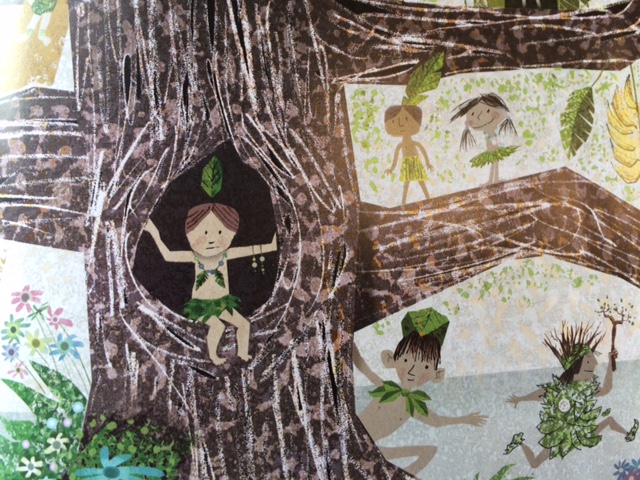
IMG_2880.JPGBUT. Take a look at the detail on the left; it comes from the book’s penultimate spread, a visually stunning wonderland that is equal parts Swiss Family Robinson and the Lost Boys from Peter Pan. And yes, it does make for a sweet ending within the confines of this book. But a child of Native/First Nations will not experience this story and these illustrations (kids with feathers or distinctly feather-shaped leaves sticking out from their heads, living a simple, primitive life) “within the confines of the book.” Children of Native/First Nations live in a world that oppresses and colonizes them and has done so for hundreds of years. And here we have a book that implies that it is okay to play “Indian,” to costume one’s self in Native dress, and the bottom line is that this is NOT okay.

I believe that Smith’s intention here was to create a kind of childhood utopia, with the giant treehouse and the lack of adult intervention and the closeness to nature and all of that; a paean to being a kid. There’s certainly nothing wrong with that! But looking back at the aforementioned piece from Teaching Tolerance, which reads in part, “To be in a tribal state is to live in an uncomplicated, traditional condition,” it gets a bit thorny. By creating the primitive scene as a sort of unspoiled, unevolved mini-society, Smith is reinforcing the age-old stereotype which led to (again quoting from Teaching Tolerance) “the concept of tribe [as] a cornerstone for European colonial rule in Africa.” And again I’ll harken back to one of Lê’s comments: using “tribe” in the title was certainly “ill-advised.”


But here’s the thing: Lê’s mixed review of the book is the exception to the rule, as There Is a Tribe of Kids has garnered 4 starred reviews to date and sits at 2nd place in the Goodreads Mock Caldecott voting. As most reviewers are White, this brings up some questions. Are we all too enamored with Lane Smith to see the problems here? To return to Zetta Elliott’s earlier point, are we able to “think critically” about and “objectively evaluate” books when they are created by someone we greatly admire? If it wasn’t Lane Smith’s name on the front cover, could we more easily see the problems inherent in There Is a Tribe of Kids? I don’t know the answers to these questions, but I do know that this is a book that I personally won’t be sharing with (human) kids.

Friday, July 1, 2016

Admirable Audacity: Speaking, Listening, Doing


In his Newbery Award acceptance speech delivered on June 26, 2016, in Orlando, Matt de la Peña told about a girl at one of his school visits who, after getting his autograph, asked, “Ain’t you gonna ask for my autograph, mister?”


And he did ask her for it, holding out his arm for her to sign. Telling the story, he said to all of us in that banquet room: “Because maybe hers is the kind of audacity it takes to be someone when you come from nothing. And maybe that’s the kind of audacity we need to assume in the book world in order to finally give young people hero choices that reflect our current population.


I’ve been thinking a lot about that girl, and what we owe her. I mean “we” collectively, the creators, the curators, the collection developers, the editors and publishers, the librarians and teachers. And not just those of us lucky enough to be in that room on June 26. All of us. Because we do owe her. She is the reason we are able to do what we do. Isn’t she?


I’ve been thinking about the meaning of “audacity” too.


I looked it up. In two different sources. The two primary definitions come down to this:


1) Boldness that is admirable
2) Boldness that is viewed as arrogant or insolent


And I realized that while the call for more multicultural books is viewed through the lens of definition one, the critiques and challenges that demand the content within those books be authentic and culturally specific are too often viewed through the lens of definition two.


We applaud and add our voices to the chorus. Yes, diversity matters!


It doesn’t even feel audacious to say it anymore, although the work of getting it done surely is.


But when critics dare to question some of the results, they speak and they write as a manifestation of definition one, but are often perceived as embodying definition two.


There is something wrong with this. Not some small thing. Some huge thing that too often divides the very people children and teens rely on. Of course there is room for disagreement in critiques of children’s and young adult literature. But there isn’t  room for closed minds. Getting it right—in a single book, in publishing, in libraries and education--is not a proscription but a process, one that isn’t carried out with good intentions alone. There is so much to be gained when those of us who can’t speak from experience listen to those who can, and who do with admirable audacity. (Redundancy intentional.)  


As he called out people to thank in his speech, Matt de la Peña acknowledged his editor and publisher, Jen Besser, saying, “Thank you for taking a chance on publishing this book and for fighting behind the scenes to keep CJ’s dialogue authentic.” He goes on to say, “You understood from the beginning that CJ would switch codes if he was at school. But he wasn’t at school. He was with his Nana on the bus.”


Right there is an example of what I’m talking about. Besser understood and fought for authentic language. The fact that there was resistance that required a fight  is discouraging. The fact that CJ is a child so real I’m sure I’ve met him, even if I can’t quite recall where, is one encouraging end result of the battle. But my adult response to CJ is not the point. At all. What is  the point, and the joy, is that child readers and listeners recognize CJ as someone THEY might know; who recognize in his world the world they inhabit too in one way or another.


Many of us are on a high from the award acceptance speeches we heard at ALA or have read or watched online since the conference. They offered moments that were thought-provoking, and at times transcendent. But will our resulting energized feelings and (renewed) commitment make a difference?


Perhaps. But only if we understand that the voices of people of color and First/Native Nations as writers, as illustrators, as commentators and critics, are essential. And only if we listen openly, actively to what they say.We can’t just wear a button or promote a slogan. We have to take meaningful action every day.  

Maybe that means finding your own allies in the sphere where you work and fighting to get those voices into libraries and classrooms, or into even into print. Maybe that means taking your limited budget and saying “I will” rather than “I can’t” when it comes to making some selection choices. Maybe it means finding the courage to say “this isn’t ok” when reviewing or evaluating books that reflect thinking that has always been racist even if you’re only coming to understand it now (even if it’s by an author you’ve always admired).  Maybe it means saying “I’m scared” but trying anyway--to listen, to learn, to be an ally.


Jen Besser was an admirably audacious ally to an admirably audacious writer.  But most of us are not editors or writers. We are reviewers and librarians and teachers. How can we be audacious? How can more publishers be audacious, too?  Think about that. Think about what you can do. What you’re already doing. Is there room for more? Is there room for different? Because we need more. We need different. Not because there aren’t amazing books. But because we know--we all know--there aren’t enough of them.

That girl who held out her arm for Matt de la Peña to sign needs to be seen now. She needs books now. And she is far from being alone.

Clap Clapping at the CSK Breakfast

If you attended the ALA Annual conference in Orlando earlier this week, I hope you made it a point to attend the Coretta Scott King Award Breakfast on Sunday morning. I have been going to the CSK Breakfast since the mid-1980s, and it's become, without question, my favorite part of the entire conference.  The speeches are always inspiring, uplifting and eloquent, and are always a reminder of why we do the work we do getting books into the hands of children and teens.

This year, Jason Reynolds gave two acceptance speeches, one for The Boy in the Black Suit and another for All-American Boys. Both were excellent, demonstrating his consummate genius with words. His second speech was brilliantly constructed as a poem, the text of which has been printed on the new Coretta Scott King Award blog. Reading the words is one thing, but actually hearing them spoken aloud by Jason Reynolds is another. His delivery was powerful and moving. Luckily, Pat Enciso had the foresight to record it with her video camera, and she has posted it, with Jason's knowledge and permission.

Read the words and watch the video. And then get to work. Buy the CSK Award books and get them into the hands of young readers.