Whiteness is difficult to see and talk about for many of us (White people) because we know it by another name – “normal”.
In The Racial Contract Charles W. Mills explains how the White normative view is established and maintained: “…what it requires to achieve Whiteness successfully, to become a White person, is a cognitive model that precludes self-transparency and genuine understanding of social realities.”
In the new Based on a True Story series from Macmillan, the White point of view is the lens through which young readers experience the timeline of United States history. The decision to contract this series with a single White author has ensured a series that will only strengthen the dominant White narrative of U.S. history while ignoring the realities and perspective of people of color and members of the First/Native Nations. By way of example, we will review one volume (which to date has not been reviewed in professional journals) in this series – Mary Jemison: Native American Captive by E.F. Abbott.
The book opens in 1743 with Mary Jemison’s pregnant mother making the transatlantic voyage to America. The passengers are weary:
“Thirty days. And still no land in sight”
“Why did we want to go to America?”
“What will we find there”
“Land to call our own”
“Wild savages”
“Freedom” (page 2)
By 1758 Mary and her siblings are helping to tend the family homestead in central Pennsylvania. “Travelers from western Pennsylvania told frightening stories. More and more colonists were attacked by savages” (page 6). In his scholarship about Whiteness, Mills details how the dichotomy of savage (in this case First Nations) and civilized person (Europeans) is constructed around the description of space:
“Europeans, or at least full Europeans, were ‘civilized’ and this condition was manifested in the character of the spaces they inhabited” (pg 42, Racial Contract). Those spaces included the cities of Europe, the colonial towns, and the settlements. Abbott devotes time to detailing how Mary’s family toiled to make the land civilized.
“The family had worked hard to make their farm. They cut down trees and pulled stumps. They built a house and barn. They had fields for crops, meadows where lambs and calves could wander, and an orchard dotted with pink apple blossoms.” (pg 4).
“NonEuropeans were ‘savages’ and this condition was manifested in the character of the spaces they inhabited” (pg 42, Racial Contract). The White narrator of Jemison’s story foreshadows the danger: “A savage would be silent.” “A savage would creep quietly through the woods – until, at the very last moment, he would whoop the death yell” (pg 8).
Mary wants to escape the the frontier and move to Philadelphia. “Let the wild animals and wild people have these woods”. The narrator repeatedly equates First/Native Nations people to animals. The Shawnee men who arrive at the Jemison’s farm “were desperate with hunger – like bears waking up from their hibernation starving and cross” (pg 21).
In selecting Jemison’s story as a way to explore the colonization of North America, Abbott inevitably casts First/Native Nations people as aggressors. According to the author’s note, the major source of information for this book was A Narrative of the Life of Mrs. Mary Jemison by James E. Seaver in 1823. Seaver wrote the book based on interviews with Jemison. Abbott found that many dates in Jemison’s recollection were inaccurate, but the larger problem with Abbott’s book is that the entire narrative of colonisation is through the eyes of a White person. Even the version of the Seneca creation story was taken from Seneca Indian Myths by Jeremiah Curtin, a White folklorist.
We can find no source information to indicate that Abbott contacted or read the accounts about Mary or the larger social history of the Seneca Nation by anyone other than White scholars of a different era. Today’s young readers will be little more enlightened than Mary was in the late 18th century. Several images are included in Abbott’s book to provide context for the historical period. Among them is this image from the Library of Congress. Note the caption on the original.
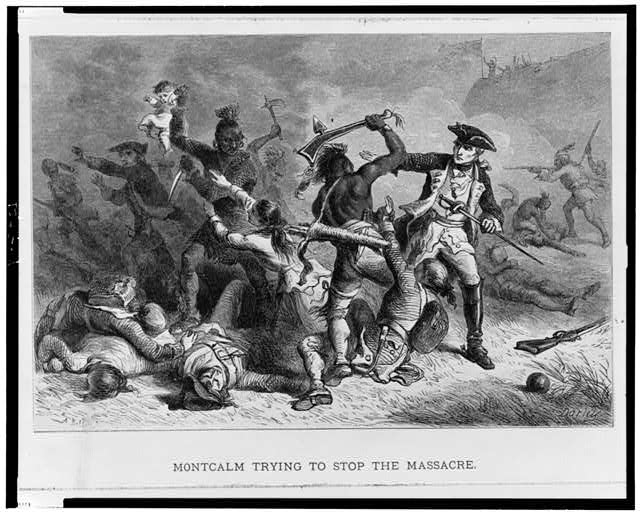
Abbott captions this image as “A wood engraving of Native Americans attacking the British during the French and Indian War.” Images and text work together to establish the members of the Seneca tribe as the aggressors.
After Mary is taken away by Shawnee men and sold to members of the Seneca Nation she begins to understand more about the First Nations.
“The Six Nations have signed a treaty with the Yengeese at Easton” Jako-ki said
“Six Nations?” Mary said
“Oneida, Onondaga, Mohawk, Cayuga, Tuscarora, and Seneca,” Jako-ki said.
The Seneca women go on to explain how many treaties have been broken. Mary recalls her father describing the First/Native Nations as savages who “didn’t deserve the land because they didn’t farm or build houses.” “Now Mary knew differently. She slept in a bark house. She ate the corn the tribes grew” (pg 94). What Mary doesn’t realize and readers are not told is that “The Seneca were the largest of six Native American nations which comprised the Iroquois Confederacy or Six Nations, a democratic government that pre-dates the United States Constitution.” https://sni.org/culture/
Nina posted a few months back about In the Footsteps of Crazy Horse by Joseph Marshall. In that review she talks about the refreshingly different perspective provided in that story, which is grounded in a First/ Native Nations point of view. The “Indian Captive” narrative has a long history in children’s literature. Lois Lenski won a 1942 Newbery Honor for her book Indian Captive: The Story of Mary Jemison. Why is it that over 70 years after Lenski’s book the same narrative (albeit poorly written and researched compared to Lenski) of White superiority over First/Native Nations is still being published? Most libraries are well stocked with narrative voices such as Abbott. Mary Jemison: Native American Captive does nothing to enlarge the scope of children’s literature. If the complete story of North America is to be told publishers need to seek out stories by more First/Native Nation authors. Mary’s story ends in her old age explaining her history (and by extension the story of the Seneca) to White kids who live nearby. The Based on a True Story series leaves contemporary kids in the same position - dependent on the White normative view to understand U.S history.