by Jason Reynolds. Atheneum/Caitlyn Dlouhy Books, 2016. 432 pages. ISBN 978-1-4814-1590-3 Click here to purchase
In just three years, Jason Reynolds has established himself as a rising star in young adult literature. As Brave As You
is his first middle-grade novel and with it, he proves himself to be just as skillful a writer for a younger audience. This is a book I want to put into everyone's hands. It's deep, funny, and original.
Eleven-year-old Genie and his older brother Ernie are city kids, used to navigating the familiar streets of their Brooklyn neighborhood. When they are sent to rural Virginia to spend a month with their grandparents while their parents work on their marriage, they both face a high learning curve. Everything is new to them -- daily chores, working in the hot sun to pick peas from the garden, and living by grandma's strict rules. Even the tea is different -- too sweet!
Ernie approaches everything with his usual Brooklyn bravado, trying to school his younger brother in how things should be done and, most of all, trying to win the affections of Tess, a wise-cracking girl his age who lives on the nearest farm. Genie prefers to hang back a bit and observe. He has a lot of questions about everything, and he writes them down in a spiral notebook to keep track of them so he can look for the answers once he access to the internet again. Being in his father's childhood home fills him with even more questions. Why doesn't his dad get along with his grandfather? What was his dad's brother, who was killed in Desert Storm, like? How can he repair the little model truck he wrecked the first day, one of the few mementos that remained from his dead uncle?
He is especially curious about his grandfather who is blind but who is just as capable as a person with sight. How does he do it? Why does he carry a gun in his waistband? And what's behind the forbidden door that Grandpop goes through every day and closes behind him? By listening to Grandpop's stories and asking him questions, Genie eventually earns his trust, and he is allowed inside the secret room, a real honor since even Grandma can't go in. Genie is amazed to learn that Grandpop has recreated the outdoors inside the room -- complete with five live, singing swallows, whom Genie names after the Jackson 5. He learns that the one thing his grandfather is afraid to do is to go outside on his own. Thus, the room.
When Genie accidentally kills Michael Jackson by feeding him apple seeds instead of dead flies, he enlists the help of Ernie and Tess. Have the brothers developed enough country smarts to catch a live swallow? And will Genie be able to replace it without Grandpop knowing before they have to go back to Brooklyn?
Throughout the novel, Genie is driven by his desire to repair the model truck and to catch a swallow, both of which give dramatic tension to the story. But it's the human relationships that give the story its heart. Like most eleven year olds, Genie is awkward and unsure of where he stands, especially with people he doesn't know well, but even, at times, with his brother, whom he admires and wants to emulate. And then there are the often inscrutable relationships between adults -- his parents, his grandparents, his father and uncle and, most of all, his father and grandfather. There's a lot for Genie to figure out but by keeping his ears, eyes, and heart open, he will learn to navigate the dynamics within his own family, which will prepare him to navigate the wider world.
Reviewed by KT Horning
Read These Folks First, Then Read Us Afterwards If You Still Have Time
- #31DaysIBPOC
- A Year of Thursdays
- American Indians in Children's Literature
- Anansesem
- Booktoss
- Brown Bookshelf
- Cotton Quilts
- Cuatrogatos Foundation
- De Colores
- Disability in KidLit
- Hijabi Librarians
- Indigo's Bookshelf: Voices of Native Youth
- Latinxs in KidLit
- Medal on My Mind
- OurStory (from We Need Diverse Books)
- Oyate
- Research on Diversity in Youth Literature
- Rich in Color
- See What We See: Social Justice Books
- Teaching For Change
- Vamos a Leer
- We Need Diverse Books
- We're The People Reading Lists
- YA Pride
Saturday, September 3, 2016
Friday, September 2, 2016
September Spotlight on #OwnVoices: Lola Levine and the Ballet Scheme
By
Monica Brown. Illustrated by Angela Dominguez. Little, Brown Books for Young
Readers, 2016. ISBN: 978-0316258449. Click here to purchase.
In the third book of the beginning chapter series featuring her name, Lola
Levine is left out of the girly girl in-group at school. Things get worse when
her buddy Josh doesn’t want to be her partner for “Twin Day.” At least she has
soccer to look forward to and her Diario
entries (Lola has a Peruvian-Catholic mom and an American-Jewish dad) in which
she can express herself. When new-girl Isabella joins the class, Lola is
curious and asks about her hobbies and Mexican heritage. When she learns that “Bella” is
obsessed with ballet and all-things-pink, Lola can’t hide her irritation. The
two skirmish with paint during a project for “Tie-Dye Day” and end up in
the principal’s office. When their mothers meet, they develop a plan for the kids to get along. The girls are forced to stretch themselves and spend time
together: first Bella at Lola’s soccer practice, then Lola at ballet. As Lola
and Bella experience new environments side by side, they bond and begin to
challenge the idea that a soccer player and ballerina can’t be friends.
As a text for emergent readers, this book features short chapters, a larger font size, and illustrative typefaces representing “handwritten” communication. The first-person story is direct, engaging, and it stands alone start to finish. While some characters likely popular in other parts of the series (including Lola’s friend Josh and little brother Ben) don’t get a lot of airtime, the spotlight on Lola and her friendship with Bella allows for the girls’ backgrounds and interests to be normalized and affirmed. Dominguez’s comforting digital illustrations (which show up in grayscale on full pages and between pieces of text) offer readers scaffolding, furthering representation of plot points as well as the characters’ identities and emotions.
Reviewed by Elisa Gall
![]() |
Lola
Levine and the Ballet Scheme
by Monica Brown, illus. Angela Dominguez |
As a text for emergent readers, this book features short chapters, a larger font size, and illustrative typefaces representing “handwritten” communication. The first-person story is direct, engaging, and it stands alone start to finish. While some characters likely popular in other parts of the series (including Lola’s friend Josh and little brother Ben) don’t get a lot of airtime, the spotlight on Lola and her friendship with Bella allows for the girls’ backgrounds and interests to be normalized and affirmed. Dominguez’s comforting digital illustrations (which show up in grayscale on full pages and between pieces of text) offer readers scaffolding, furthering representation of plot points as well as the characters’ identities and emotions.
Reviewed by Elisa Gall
Thursday, September 1, 2016
September Spotlight on #OwnVoices: A Hand To Hold
![]() |
| A Hand To Hold by Zetta Elliott, Ill. Purple Wong |
The start of the school year comes packed with emotions, especially for the youngest students and their families. Drop-off tends to be the most fraught moment of the day--and no drop-off is more emotional than the one that happens on the very first day of school.
Which brings me to Zetta Elliott's sublimely written A Hand To Hold. A little girl thinks about her daddy's hands, how they helped her take her first steps, pushed her sky-high on the swing, and gently cared for her scraped knee. How will she be able to let go of daddy's hand when he drops her off at school for the very first time?
Children--especially those in preschool and kindergarten--are simultaneously dominated by their emotions and by their physical experiences. They experience the pain and fear of separation, but often can't process language like "you'll see mommy again when she comes to pick you up at the end of the day" ("the end of the day" is too abstract). I'm always struck by how physical comforts aid separations more effectively than soothing language. Children clutch favorite books, blankets, toys, stuffed animals, teacher's hands, or--most effective of all--get a hug or hand-hold from a classmate.
Zetta Elliott masterfully creates a perfect connection between a child's emotional and physical worlds. Daddy shows his little girl that though she will have to let go of his hand, she can keep him in her heart all day long, just as he will keep her in his. And when she does let go of daddy's hand (after some very realistic tears), she finds a new friend's hand ready and waiting.
Though the art may strike some grown-ups as amateurish, children will be too focused on the visual hand-holding cues to care. At once developmentally appropriate and exquisitely written, with a story that anyone experiencing separation will appreciate (especially those on the lookout for books about loving and caring fathers), A Hand To Hold is a much-needed book.
Reviewed by Allie Jane Bruce
Tuesday, August 30, 2016
Coming in September: Spotlight on #OwnVoices
Here at Reading While White we are approaching our first anniversary, and we've decided to celebrate by focusing on the positive for the month of September. Rather than talking about what's wrong in children's and YA books, we're going to talk about what's right. We want to shine the spotlight on some of the amazing books that have been written by authors and artists of color and Native authors and illustrators.
We've been inspired by Dr. Ebony Thomas and her graduate students at the University of Pennsylvania who've tweeted daily book recommendations under the tag #HealingFictions as part of their Humanizing Stories project. We've also been inspired by Corinne Duyvis who created the #OwnVoices hashtag to recommend books with diverse characters created by authors and illustrators from the same diverse group.
The RWW team is committed to posting a review each day during the month of September of a book we highly recommend that represents #OwnVoices. Most of them will be new books, but we'll also include a few that have been around a while.
There are a lot of great #OwnVoices books out there that we want to shine a spotlight on. We hope you will be inspired to find these books, check them out, buy them, read them, talk about them, and share them with the children and teens in your lives. And don't do it just because these books represent diversity. Do it because they're great books!
Friday, August 26, 2016
When We Was Fierce - Rounding Up the Links
Candlewick's decision to pull e.E. Charlton-Trujillo's young adult novel When We Was Fierce days before its publication date has lots of people talking. Below you'll find a collection of links to the many discussions surrounding the situation. Meanwhile, the book recently received its fourth starred review (from the Bulletin for the Center of Children's Books) and a favorable review from VOYA.
The Getdown and When We Was Fierce - Latinas Chat Media (featuring Maria Nieto, Linda Nieves-Powell, Sophia Quintero, and J.F. Seary; starts near the 40-minute mark)
On Choosing Texts for Students - Millie Davis, NCTE blog
Publisher delays YA novel amid row over invented black 'street dialect' - Alison Flood, The Guardian
It Isn't Censorship When A Publisher Pulls An Offensive Book: It's Good Business - Justina Ireland, Book Riot
"When We Was Fierce" Pulled as Demand Grows for More #OwnVoices Stories - Lauren Barack, School Library Journal
So You Bought A Racist Book For Your Library: Now What? - Angie Manfredi, Reading While White
When We Was Fierce + A Birthday Cake for George Washington + A Fine Dessert... - Debbie Reese, American Indians in Children's Literature
What Does When We Was Fierce Mean for Latinx Kids? - Dr. Sonia Alejandra Rodriguez, guest post on Crazy QuiltEdi
Can You Hear Us Now? - Edi Campbell, Crazy QuiltEdi
Review: When We Was Fierce - Pernille Ripp
Bad Representation is Bad Writing - Laura Pohl
The Rocky Unpaved Roads of Good Intentions - Ibi Zoboi, guest post on Reading While White
Black Voices Matter - Zetta Elliott
When Whiteness Dominates Reviews - KT Horning, Reading While White
Review: When We Was Fierce - Edi Campbell, Crazy QuiltEdi
Guest Review: When We Was Fierce - Jennifer Baker, guest post on Crazy QuiltEdi
You can also see discussion regarding When We Was Fierce on twitter by searching #jivefierce.
Tuesday, August 23, 2016
Reviewing While White: Mary Jemison, Native American Captive.
By Ernie Cox
Whiteness is difficult to see and talk about for many of us (White people) because we know it by another name – “normal”.
In The Racial Contract Charles W. Mills explains how the White normative view is established and maintained: “…what it requires to achieve Whiteness successfully, to become a White person, is a cognitive model that precludes self-transparency and genuine understanding of social realities.”
In the new Based on a True Story series from Macmillan, the White point of view is the lens through which young readers experience the timeline of United States history. The decision to contract this series with a single White author has ensured a series that will only strengthen the dominant White narrative of U.S. history while ignoring the realities and perspective of people of color and members of the First/Native Nations. By way of example, we will review one volume (which to date has not been reviewed in professional journals) in this series – Mary Jemison: Native American Captive by E.F. Abbott.
The book opens in 1743 with Mary Jemison’s pregnant mother making the transatlantic voyage to America. The passengers are weary:
“Thirty days. And still no land in sight”
“Why did we want to go to America?”
“What will we find there”
“Land to call our own”
“Wild savages”
“Freedom” (page 2)
By 1758 Mary and her siblings are helping to tend the family homestead in central Pennsylvania. “Travelers from western Pennsylvania told frightening stories. More and more colonists were attacked by savages” (page 6). In his scholarship about Whiteness, Mills details how the dichotomy of savage (in this case First Nations) and civilized person (Europeans) is constructed around the description of space:
“Europeans, or at least full Europeans, were ‘civilized’ and this condition was manifested in the character of the spaces they inhabited” (pg 42, Racial Contract). Those spaces included the cities of Europe, the colonial towns, and the settlements. Abbott devotes time to detailing how Mary’s family toiled to make the land civilized.
“The family had worked hard to make their farm. They cut down trees and pulled stumps. They built a house and barn. They had fields for crops, meadows where lambs and calves could wander, and an orchard dotted with pink apple blossoms.” (pg 4).
“NonEuropeans were ‘savages’ and this condition was manifested in the character of the spaces they inhabited” (pg 42, Racial Contract). The White narrator of Jemison’s story foreshadows the danger: “A savage would be silent.” “A savage would creep quietly through the woods – until, at the very last moment, he would whoop the death yell” (pg 8).
Mary wants to escape the the frontier and move to Philadelphia. “Let the wild animals and wild people have these woods”. The narrator repeatedly equates First/Native Nations people to animals. The Shawnee men who arrive at the Jemison’s farm “were desperate with hunger – like bears waking up from their hibernation starving and cross” (pg 21).
In selecting Jemison’s story as a way to explore the colonization of North America, Abbott inevitably casts First/Native Nations people as aggressors. According to the author’s note, the major source of information for this book was A Narrative of the Life of Mrs. Mary Jemison by James E. Seaver in 1823. Seaver wrote the book based on interviews with Jemison. Abbott found that many dates in Jemison’s recollection were inaccurate, but the larger problem with Abbott’s book is that the entire narrative of colonisation is through the eyes of a White person. Even the version of the Seneca creation story was taken from Seneca Indian Myths by Jeremiah Curtin, a White folklorist.
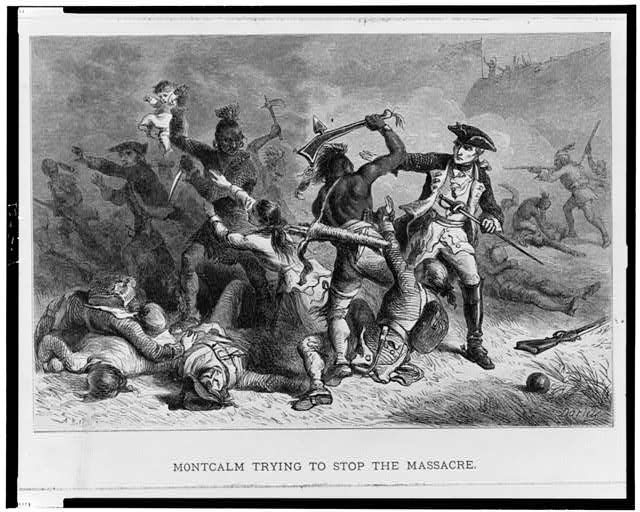
We can find no source information to indicate that Abbott contacted or read the accounts about Mary or the larger social history of the Seneca Nation by anyone other than White scholars of a different era. Today’s young readers will be little more enlightened than Mary was in the late 18th century. Several images are included in Abbott’s book to provide context for the historical period. Among them is this image from the Library of Congress. Note the caption on the original.
Abbott captions this image as “A wood engraving of Native Americans attacking the British during the French and Indian War.” Images and text work together to establish the members of the Seneca tribe as the aggressors.
After Mary is taken away by Shawnee men and sold to members of the Seneca Nation she begins to understand more about the First Nations.
“The Six Nations have signed a treaty with the Yengeese at Easton” Jako-ki said
“Six Nations?” Mary said
“Oneida, Onondaga, Mohawk, Cayuga, Tuscarora, and Seneca,” Jako-ki said.
The Seneca women go on to explain how many treaties have been broken. Mary recalls her father describing the First/Native Nations as savages who “didn’t deserve the land because they didn’t farm or build houses.” “Now Mary knew differently. She slept in a bark house. She ate the corn the tribes grew” (pg 94). What Mary doesn’t realize and readers are not told is that “The Seneca were the largest of six Native American nations which comprised the Iroquois Confederacy or Six Nations, a democratic government that pre-dates the United States Constitution.” https://sni.org/culture/
Nina posted a few months back about In the Footsteps of Crazy Horse by Joseph Marshall. In that review she talks about the refreshingly different perspective provided in that story, which is grounded in a First/ Native Nations point of view. The “Indian Captive” narrative has a long history in children’s literature. Lois Lenski won a 1942 Newbery Honor for her book Indian Captive: The Story of Mary Jemison. Why is it that over 70 years after Lenski’s book the same narrative (albeit poorly written and researched compared to Lenski) of White superiority over First/Native Nations is still being published? Most libraries are well stocked with narrative voices such as Abbott. Mary Jemison: Native American Captive does nothing to enlarge the scope of children’s literature. If the complete story of North America is to be told publishers need to seek out stories by more First/Native Nation authors. Mary’s story ends in her old age explaining her history (and by extension the story of the Seneca) to White kids who live nearby. The Based on a True Story series leaves contemporary kids in the same position - dependent on the White normative view to understand U.S history.
Thursday, August 18, 2016
On White Fragility, by Guest Blogger Justine Larbalestier
![]() |
| Author Justine Larbalestier. Photo by Niki Bern. |
My theory is that it makes us feel like we are the baddies. A notion we recoil from because we have been taught all our lives that white people are the goodies. So many of our stories are about us saving (some part of) the world from racism and exploitation: Dances with Wolves, The Help, Avatar (some other world) etc. All too often in these stories, as in probably the most famous example, To Kill a Mockingbird, we're also the baddies doing the terrible things but that's okay because we're the white saviours.
The story we often tell ourselves about white colonialism is that we saved the "savages" from their brutish, cannibalistic lives by giving them Christianity and civilization. We tend to edit out our "gifts" of small pox, massacres, slavery, and the fact that the vast bulk of verifiable incidents of cannibalism were committed by white people. *Cough* Donner party.
Coming to terms with the fact that, not only are we not the goodies, that historically we are, in fact, the big bad is not easy. Nor is realising that individually we white people can, and frequently do, hurt people on a daily basis because we don't think about how our whiteness smooths our path for us while flattening others.
When we are called on our (usually) unthinking racist statements and acts we tend to fall apart. All too often other white people rally around to tell us that the problem is not what we’ve said or done—nope, it's those mean people calling us on it.
“I'm a good person. I can't be racist.”
This spectacle is called white fragility.
It doesn't have to be that way. We white people can get out of our own way.
Here's what I do when a Person of Colour or an Indigenous person calls me out (in the non-duelling sense):
1. Assume they're speaking in good faith because they know more about racism than I do. Too many of us whites are convinced we know more about racism than the people who actually experience it. We don't. Even those of us with PhDs on the subject. Someone saying something mean about us because we're white is not the same as systemic racism.
2. Listen. That uncomfortable feeling? I've learnt that it's a good thing. I no longer run away from it.
3. Learn. This is the part where I figure out why the criticism is making me feel uncomfortable. Always remembering that feeling uncomfortable is nothing compared to being subjected to racism. Discomfort isn't lethal.
4. Assume that the calling out is not about me but about making the world a less racist, more equitable place.
5. Do what I can to make the world a less racist, more equitable place. Obviously, this is the hardest part.
Ways white writers can make the world (or publishing, at least) a less racist, more equitable place:
To help diversify YA, we white authors can support Indigenous authors and Authors of Color by reading their books, recommending their books, blurbing their books, and recommending them to our agents. When we're invited to conferences, or festivals, or to be in anthologies, make sure they're not majority white. We need to make more space for People of Colour and Indigenous people in our very white publishing industry.
These are by far the most important things we can do personally to increase diversity.
However, I keep seeing white authors getting hung up on whether white people are allowed to write from points of view not our own. Spoiler: we're allowed. No one is stopping us. Will doing so make YA more diverse? No, it won't.
Obsessing over that question has little to do with making YA a more diverse genre and everything to do with centering the concerns of white authors. A more important contribution to making YA more diverse would be to stop obsessing about it. Yes, we were taught by To Kill a Mockingbird that racism can be solved by a well-intentioned white person saving the day, but maybe it's time to say goodbye to that more-than-fifty-years-old model.
Recently I've said I'm going to focus on writing white main characters in my single point of view novels. That's a personal decision. I've not told anyone else to do likewise. This decision is also not much of a contribution to diversifying YA. It's about my journey grappling with my whiteness and racism and fragility.
My name is Justine Larbalestier and I'm white and fragile.
For too long time I believed in being a white saviour. I thought that by writing from the point of view of a Person of Colour I was helping make YA more diverse. I was helping YA's diverse readership see themselves represented. There were so few books for them! I was supplying the lack! I was doing good!
For years the response to my books—glowing reviews, award nominations, fan letters from People of Colour—supported my belief that I was doing good.
I had read critiques of the white saviour complex but was sure they didn't apply to me. But one day in early 2009 a black woman blogger wrote a critique of my novel Liar.
Liar has a black teen protagonist. The blogger wrote that the book hurt her, that it was full of painful tropes, and that she would not read anything else I wrote unless it was not about People of Colour because I could not be trusted with the stories of anyone who isn't white. Further, that she wasn't going to read any more books with PoC protags by white people because we always get it wrong.
I felt like I'd been punched.
It was the most painful criticism any of my books had ever received and I've had reviews call for my books to be burnt and me to be slapped.
I sent the critique to several friends so they could reassure me she was wrong.
Yes, in the face of someone literally stating she had been hurt by the racist tropes in my book, all I wanted was reassurance. I thought my hurt feelings were more important than her actual pain.
That right there is white fragility.
I'd love to tell you that I understood that at the time. I didn't.
I knew enough not to say anything publicly. I just moaned to my friends.
Not long afterwards people started realising that the cover of Liar had been whitewashed. That particular blogger wrote brilliant critiques of the whitewashing. She was one of the many voices who helped get the cover changed. I continued to follow her work online and found myself agreeing with the majority of it.
Which only made her criticism burn more. She was right about so many other things, did that mean she wasn't wrong about my book? I wanted to believe she was wrong. My friends had told me she was. Besides, she'd gotten several details of the plot wrong. Clearly her anger blinded her. It was an angry, disgusted, sarcastic review. She used the word "ugh" a lot. She wasn't being reasonable.
I ignored the critique and went on to write (with Sarah Rees Brennan) yet another book with a PoC main character, Team Human. This time the protagonist was Chinese American. There were no critiques from well-known bloggers. I saw one or two reviews on Good Reads by Chinese American reviewers who had problems with it. But it got great trade reviews! Lots of other Chinese American readers loved it!
I kept thinking about that review. More and more blog posts and articles were appearing about the lack of PoC and Indigenous writers in YA and the need for diversity. The conversation was starting to shift from merely being about representation. There was growing talk about who wrote those trade reviews, who gave out those awards. Overwhelmingly white people.
I'm not sure when it happened but sometime in the last few years, amidst the growth of #WeNeedDiverseBooks and #OwnVoices, I started to realise that blogger was right. Of course she was right. Liar had hurt her. I had hurt her. More than that, I finally realised her critique was not about me. It wasn't all that much about my book, either.
She was explaining what it's like to read books by white people that purport to be about people like her, that arrogantly trample on her lived experience, without a thought as to how that affects her. She was saying she'd had enough. She didn't trust white writers like me. And why should she?
We white people tend to judge books individually and not within the wider context of systemic racism. PoC and Indigenous readers don't have that luxury. They can't step outside their lived experience. The racism in one particular book might seen mild—or even invisible—to white me, but for the PoC reader who has been bombarded with those tropes over and over and over again, it's too much.
Her critique showed me how high the stakes are.
Before I read her critique I had never seriously considered the harm I could cause writing PoC and Indigenous characters.
Her angry, disgusted, sarcastic critique was what finally got through to me.
The fact that it took me so long to hear what she was saying also made me realise that there is no way to talk about white privilege or racism that doesn't get heard by many white people as an attack. Even if she had written her critique in a nice way I'd still have felt gut-punched.
Frankly, back when I first read that critique I'd read hundreds of books and articles about white privilege, white supremacy, appropriation, diversity, racism. Most of them written very nicely indeed with nary an angry word. I'd not thought any of them had much to do with me because I was sure that I'm one of the good ones. Like that nice white lawyer in To Kill a Mockingbird who saves the day.
Frankly, her anger got through to me more effectively than if she had been nice.
Except.
I reread that critique while writing this essay. Here's the thing: it wasn't that angry or sarcastic. It was more sad and disappointed.
It sounded angry to me back then because I didn't want to think about how my books weren't helping YA to become diverse. I didn't want to think about how I was part of the problem. I wasn't ready to listen so I heard it as angry yelling.
Until we white writers are ready to listen, until we're ready to accept that, yes, we are a part of systemic racism, yes, we benefit from white supremacy, it doesn't matter what the tone is, we won't be able to hear or understand what's being said.
A big part of why we find it so hard to listen is that we whites are rarely taught about race. Unless we're very lucky, our parents don't sit us down and explain it. Our teachers mostly don't either. Most of us have not been prepared to think or talk about race. As a result most of us will literally do anything we can to avoid talking about it.
This feeling that we're the baddies is so uncomfortable we change the subject as soon as possible.
Or, just as bad, we follow through on naive notions about how we can fix it. You know, like writing a nice book about a good white lawyer who tries to save a black person from being jailed for a crime they didn't commit because they've been framed by a bad white person and now racism is over. Yay! A white man once told me that was the most important novel ever written about race. He wasn't joking.
We white people have much unlearning to do. Step one: throw away the myth of the white saviour. Let other communities speak for themselves.
Note: Thank you, Alaya Dawn Johnson, Scott Westerfeld and Doselle Young for your feedback on earlier drafts of this essay. All remaining infelicities of expression and unclarity are mine all mine. I'd also like to thank Edi Campbell and Debbie Reese for their amazing blogs. They are two of the best resources out there on YA, Children's Literature and representation of PoC and Indigenous people. For some of the other people who have shaped my thinking on these issues check out the people I follow on Twitter.
Although the single point of view novels I write now have white main characters they are not all-white books. I don't live in an all-white world so I don't write all-white books. The books I'm working on that have multiple point of view characters are also not all-white.
I didn't name the blogger I discuss above because she critiqued my book without naming it. She did that because she was tired of white people yelling at her every time she critiqued a book for being racist. I wasn't about to point more of them in her direction.
Justine Larbalestier is an Australian-American author of eight novels. Her most recent, My Sister Rosa, is about a seventeen-year-old boy whose ten-year-old sister is a psychopath. It was published in February by Allen and Unwin in Australia and New Zealand and will be out in North America in November published by Soho Press. Her previous novel is Razorhurst, which takes place on a winter’s day in 1932 when Dymphna Campbell, a gangster’s moll, and Kelpie, a street urchin who can see ghosts, meet over the dead body of Dymphna’s latest lover, Jimmy Palmer. Her most popular novel, Liar, is kind of self explanatory, i.e. it’s about a liar. She edited Zombies versus Unicorns with Holly Black. Her other novels include How to Ditch Your Fairy and the Magic or Madness trilogy.
Ed. 6/20/20 by Allie: Due to too much spam, I'm closing the comments on this post. If you want to leave a comment here, email us: readingwhilewhite@gmail.com
Subscribe to:
Posts (Atom)