Showing posts with label Nostalgia Reviews. Show all posts

Thursday, October 11, 2018

The Privilege of Nostalgia

When I first learned about Jane Mount’s Bibliophile: An Illustrated Miscellany, I was excited. (I love books! This is a book about loving books? What is there not to love?!) My heart sank, however, when I saw this preview spread of the “Formative Faves” page via Amazon:


Almost every book featured in this spread was written by a White personand one of them is Little House on the Prairie. (I'm not sure that having your humanity denied to you through racist depictions and erasure in literatureboth singularly and systemicallyinspires bibliophilia.) Every human illustrated on this page is depicted with the same shade of pinky-pale skin. I know that this is just one spread of the book, and there are attempts elsewhere to include voices of readers and authors of varying identities; still, the message this particular spread sends to me is that the “Formative Faves” page was made with White readers in mind.


The stories I read in my own formative years are not too different from those listed in the book. If I made a list of my favorite books from when I was a kid, only one title would be a book by an author of color. There are more racist titles by White people in my childhood memories than authentic multicultural stories or #OwnVoices texts. I can’t change what I read as a child, nor can I deny my majority-White authored reading history. I will never know how much I missed out on, how many stories I did not get to hear, because creators were not given opportunities to write or publish their own stories and also because my grown-up gatekeepers did not give me access to all of the books that were published. I will spend a lifetime trying to understand the effect this lack of connection to these stories and problematic representation in these stories had on my development and socialization. I must continue working to unlearn the lessons taught subtly and explicitly through the stories I did and did not (and still today, do and do not) have opportunities to read.


When I think about my childhood reading, I can choose not to think about the racist books I loved. Because I do not face racism as a White person, it is easy for me to (though I am working to not do this) fall into the trap of making racism a “thought experiment” or glossing over what is problematic. This is all a result of privilege. I don’t have to carry the trauma of having to suffer through book lists, read alouds, and a celebrated ‘canon’ of books that dehumanize or erase me because I am White. When I think about my childhood reading experiences and I feel warm and fuzzy, these feelings are a result of all of the books I connected with as a kid, the books that affirmed me, all of the racial mirrors I had (taking Rudine Sims Bishop’s metaphor into account). Those feelings of coziness and belonging are NOT universal, and White readers like me have to stop pretending that they are. Racist books, even those from the past, are not ever reflective of the way all people “thought back then.” As long as there have been books, there have been people fighting racism in booksand today, with more knowledge, I can be thoughtful in choosing which books from my past I want to celebrate in my present.


Nostalgia for a racist institution like #kidlit (or politics, or school, or film, or theater, or fine art) will always support racism. Because children’s lit is an institution brimming with White supremacy culture, nostalgia reflects and perpetuates this reality. In our capitalistic society, #kidlit book nostalgia has also been commodifiedand its racism has been embedded in that too. Do you love Out of Print clothing? Take a look at how many T-shirts you can buy that celebrate books by creators of color (not many). How about MerryMakers dolls or the children’s literature posters made by Litographs? See how few IPOC artists are represented in what is available.


I’m not saying that people should not celebrate a favorite book or author with a tote bag or other merchandise. I am asking my fellow White people to think more about what the tote bag selection says about the industry and its history, and what systems these collections of merchandise continue to support. Book nostalgia and capitalism will never stop chugging out book-themed stuff for us to consume, but librarians, teachers, and readers can work to see how this too is part of the push to romanticize the pastand that ‘looking back’ also impacts our culture of today. Whenever and however we celebrate this past, and assume that readers’ formative experiences were positive and affirming, who are we assuming as the default audience? When White stories, creators, and readers are centered over and over and over againWhite people like me are being told that we matter more. That our stories matter more. That our lives matter more. We see this in the “classics.” We see this in what book T-shirt options exist. And this has a direct connection to the inequities we see today, from the practitioner end (for example, the lack of racial diversity in upcoming conference lineups like #mra50) and publishing (see CCBC’s most recent statistics on racial diversity in children’s book publishing).


Last month I had a chance to visit the American Writers Museum. In the room focused on children’s literature, there is a mural celebrating children’s “classics.” Unsurprisingly, this mural reflects both the lack of diversity in children’s literature as well as the overt (yet unchallenged in this display) racism in titles like Little House in the Big Woods and Island of the Blue Dolphins. Until there is equity in the children’s literature ecosystem, there will never be equity in our culture of #kidlit nostalgia or celebrations of the classics. We can’t erase nor can we forget the past, but we can choose when, why, and how much to focus on it. We can intentionally examine this past critically, following the lead of people doing this now using the hashtag #DisruptTexts. We can work to understand our nostalgia and the purpose it serves. Hopefully this work will translate into action, including conscious choices to focus less on upholding and romanticizing the past and more on what changes needs to happen, and what excellent books can be celebrated, today.

Friday, September 29, 2017

Looking Back: Teammates by Peter Golenbock, ill. Paul Bacon

Teammates by Peter Golenbock, ill. Paul Bacon.  HMH Books For Young Readers, 1990. 9780152842864. Click here to purchase.


When I was in fifth grade, my teacher assigned us an essay on our hero (original, I know).  I was in the middle of a major Jackie Robinson phase.  I loved the whole “courage not to fight back” mantra, the way he played (have you seen him steal home?), and especially, the book Teammates written by Peter Golenbock and illustrated by Paul Bacon.  So when I heard about the assignment, I knew immediately who I would write about.


I came home and told my mom about the assignment.  “Who do you think you’ll write about?” she asked.  Herman “Pee Wee” Reese, I said.  The guy who, by putting his arm around Jackie Robinson’s shoulders in full view of a crowded stadium, hushed the bigoted spectators and bought Robinson a bit of a respite from the hate and vitriol regularly hurled at him.


“No, you won’t,” my mom said decisively.  I was surprised, since like me, she was a big Robinson, Reese, and Teammates fan.  Also, she rarely interfered in my schoolwork.


“Uh, why?”  I said.


“You may write about Jackie Robinson, or you may write about them both,” she said.  “You will not elevate a White man to hero status, especially over Jackie Robinson, for the mere act of putting his arm around someone’s shoulders.  Jackie Robinson was the real hero.”  (Those probably weren’t her exact words, but that’s how it’s enscripted in my memory.)


Jackie Robinson steals home in Game 1 of the 1955 World Series.
I was stunned.  I’d never thought of it that way, but it was true--I took a hard look at what Jackie Robinson endured and accomplished: Broke the color line in baseball nearly two decades before Freedom Summer.  Became the first pro athlete to have his number retired.  Posthumously awarded the Congressional Gold Medal and Presidential Medal of Freedom.  Helped found a Black-owned and -operated bank based in Harlem.  Marched with Martin Luther King Jr. at the March on Washington.  Stole 197 bases.  Retired with a .409 on-base percentage and a stellar fielding record.  And then I took a hard look at what Reese did:  Refused to sign a petition, circulated by his fellow players, to prevent Robinson from joining the team; and, put his arm around Robinson’s shoulders, essentially telling a hateful crowd to shut up.  Although Reese was certainly admirable, Robinson was undoubtedly heroic.


And then I was forced to self-examine.  Why had I, despite being so thoroughly obsessed with Robinson, defaulted to Reese as my hero?  And what did that say about me?  11-year-old-me didn’t have the language or tools to grapple with this, but I had a vague sense that it was something very ugly within me, a predilection for White saviorism and a willingness to elevate White people over Black people even within the Civil Rights movement, thereby co-opting that movement.  For years after this incident, I connected this vaguely negative, un-articulable feeling to the book that had spurred it.  I put Teammates aside for a long time.


Roughly fifteen years later, I revisited it in the midst of a long process of re-educating myself about race and racism, and Teammates is now once again a favorite of mine.  I’ve been thinking about it non-stop over the past week, in light of the protests of police brutality and institutional racism launched by Colin Kaepernick and the resulting national conversation.  I feel certain that some of the commentators demanding that the NFL “keep politics out of sports” would benefit from reading Teammates, which reveals the truth that politics is already, and always has been, in sports.  And, I always encourage educators to be thoughtful and deliberate in how they read and teach Teammates to children.


In Teammates, straightforward and accessible text pair with a combination of black-and-white photographs and painterly watercolors to tell the story of the Robinson/Reese friendship.  Segregation, the Negro Leagues, the KKK--Golenbock uses just the right level of detail to skillfully set the historical context, yet this is no “single story” of Black pain.  Even as the injustices of segregation are listed, the Negro Leagues are introduced as “two wonderful baseball leagues”.


I wish Golenbock had devoted similar space to the more positive and uplifting aspects of Robinson’s character and backstory; the list of indignities to which he was regularly exposed, from fellow Dodgers (I will not call them “teammates”) refusing to eat with him to pitchers aiming at his head, is gut-wrenching, as is the palpable tension and discomfort in Robinson’s face and body language in the team picture that appears in the book.  It would have been nice to balance these painful elements with positive stories of Robinson’s incredible sports feats, home life, and family.


The 1947 Dodgers.  Most of the (White) players appear comfortable and relaxed; Jackie Robinson sits with his arms and legs held tight into his body and his brow furrowed, appearing tense and uncomfortable.
Details of Reese’s life are similarly sparse in Teammates.  We get the highlights: he grew up in the thick of segregated Louisville, KY; the Cincinnati spectators hurling hate and bigotry at Jackie Robinson could have been his neighbors.  Reese must have had a strong moral compass to fly in the face of his upbringing and most of the Dodgers by forming a friendship with Robinson, and a strong backbone to demonstrate that friendship publicly, but Teammates manifests the arm-around-the-shoulders moment a little too simplistically.  I could see these final pages becoming fodder for a White Savior narrative in the hands of an irresponsible educator or caregiver.  I could also see it becoming a highly useful tool for teaching about advocacy and taking risks to stand up against bullies and oppressors in the hands of a skilled teacher.  As is true for so many books, its substance depends on its delivery.


As a White adult learning about anti-racism, returning to once again study Pee Wee Reese’s story was invaluable for me.  Segregation and other forms of racial oppression would have been part of the landscape during Reese’s childhood.  The buzzwords and acronyms so dear to me would not have been part of his vocabulary.  When he refused to sign a racist, anti-Robinson petition circulated by other Dodgers, he famously said, “I don’t care if this man is black, blue, or striped--he can play and he can help us win.”  I steer clear of language like this, and encourage others to do the same, since it trivializes very real injustices and promotes a colorblind view of the world that is only available to racially privileged White people.


And yet, Pee Wee Reese is a strong role model for White people like me.  When Jackie Robinson signed with the Dodgers, everyone expected him to take Reese’s position: shortstop.  Reese was the only player who actually stood to lose something from Robinson’s presence, and yet, he was the one who refused to sign the petition attempting to keep Robinson off the team.  When asked about this, Reese simply answered that he’d thought, “If he’s good enough to take my job, he deserves it.”


Ultimately, Robinson started as first baseman, and then moved to second, while Reese stayed at shortstop.  I don’t know this history thoroughly enough to know why Robinson was never made shortstop; given his stellar fielding, it would have made sense for him to play his natural position, and keeping him at second base may well have been an injustice against him.  It seems, though, that it was not Reese’s decision; he was perfectly willing to cede the coveted shortstop spot.  And his refusal to sign the petition took much of the wind out of its sails.


These are acts of White allyship (NOT saviorism) from which I can learn.  It’s easy to learn the jargon and concepts of anti-racism.  The true test comes when I am asked to give up something real, something material, perhaps something related to money or physical safety.  I can attend every anti-racist training, read every book, and know every buzzword--at the end of the day, what matters is whether, like Pee Wee Reese, I lead with compassion and a willingness to make real sacrifices.


This is the angle I would highlight, were I to read Teammates to kids (I haven’t yet, but am planning to this year). Don’t get me wrong; the arm-around-the-shoulders thing is important.  It takes real courage to stand up to bullies and say “You are wrong, and I am standing with the person you are targeting;” and, one can easily slip into grandstanding with actions like these.  I don’t believe Reese was grandstanding; from what I’ve read, he made a habit of openly and publicly chatting with Robinson at the beginning of games, particularly those with especially vitriolic spectators, with the deliberate intent of getting the hate-filled crowds to back off.  Robinson talked openly about how much he appreciated these actions.  But, I do think that it’s easy to slip into public displays of allyship (i.e., grandstanding) that draw attention away from the systemic changes needed to make real progress.  So, while I would support children who are inspired by the arm-around-the-shoulder narrative, I’d encourage them to focus more on Reese’s willingness to sacrifice the shortstop position and his refusal to sign the petition.


And, of course, I’d make sure to backend it with Stealing Home by Robert Burleigh and Promises To Keep by Sharon Robinson and maybe a documentary or even a screening of 42.  I’d make sure that kids understand the difference between advocacy and heroism.  (And that Jackie Robinson stole home 19 times.)


And I’d make sure that White kids know that while Jackie Robinson is the hero in this story, I deeply respect and admire Reese.  It is hard to provide positive examples of anti-racist White people to children.  Too often, we White adults provide negative examples--what not to be--or else slide into stories of the Great White Hope.  Teammates, when read thoughtfully, can be a powerful story of a role model, an example for White kids to live into rather than avoid.  I’d like to think that it was this need for a positive example that led eleven-year-old me to latch onto Teammates; in reality, I think I just liked the White savior story I’d internalized.  But with some deep conversation and thoughtful reading, maybe I could have understood the nuances in Teammates a little better.  And then, I could perhaps have understood that while I can never be a hero like Robinson, I can strive every day to be a teammate like Reese.

Jackie Robinson and Pee Wee Reese

-Allie Jane Bruce

Thursday, September 28, 2017

Looking Back: The Yearling by Marjorie Kinnan Rawlings

Today we are featuring a Looking Back post by Diane Bailey Foote. Diane is Curator of the Butler Children's Literature Center at Dominican University in River Forest, IL. Thank you, Diane!

Original cover of The Yearling.
"Let me talk to you a little bit before you read this," said my dad when I was about nine years old. He handed me a paperback copy of The Yearling by Marjorie Kinnan Rawlings, which had been published in 1938, and had won a Pulitzer Prize, although that distinction was lost on fourth-grade me in 1976. "You're going to read language in here that isn't correct. I want you to know this isn't the way I expect you to read and write, but I don't want you to look down on the people who speak this way in this book. This is the way they learned to speak at that time." Of course, he was referring as much to relatively innocuous vernacular dialogue spoken by the poor, rural White Floridians such as "That's what I figgered," "sich as that," or "Them that steals offen us;" as he was to flat-out racist terms such as "Injuns," or saying in criticism that someone has "a heart as black as midnight."
Of course, this really is how the people in the book would have spoken at the time and place it was set. Unfortunately, when a narrator uses objectionable language, even a 1930s narrator, it is somehow harder to accept than when such terms are spoken by a book's characters. For example, in describing a pet raccoon, the narration reads: "A tiny black paw, like a n*****’s baby's hand, reached out." Seriously!? I honestly don't remember how I reacted to this kind of sentence at age nine, but reading it today makes me angry, because it's so unnecessary and mars what is otherwise an enduring work of writing that is both critically acclaimed and popular. I recognize now that my nine-year-old White self was privileged to just kind of blow past that; for kids who may have been called that name, it wouldn't have been so easy. It's especially jarring, because this very scene, in which main character Jody's friend Fodder-wing is introduced, is remarkable in its ahead-of-its-time treatment of a person with a physical disability. Fodder-wing, the youngest son in the large Forrester family, neighbors to Jody's family, was born with a "hunch-backed frame" and people think he's "witless." But Jody, the main character with whom readers sympathize and identify, sees and values him for who he really is: a kind boy and a gentle friend to people and animals.
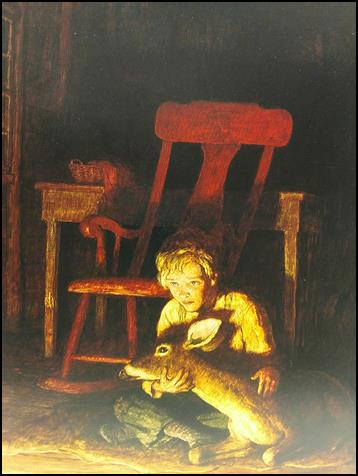
Internal illustration by N. C. Wyeth, "Jody and Flag"
The storyline itself remains compelling and, for the most part, exquisitely written, today. Jody Baxter is an only child living in an isolated setting; his family's cabin is located on what was called "Baxter's Island," not a true island but a clearing in the scrub. It is a harsh life, with constant struggle for survival against starvation, illness, and predatory animals; it is also beautiful, with Jody finding joy in nature when he can sneak away from his endless chores. His "Ma" is not overly warm or maternal; his father, known as "Penny" both for his small stature and for being "sound as copper itself; and with something, too, of the copper's softness." Jody longs for companionship and befriends a young fawn after Penny, bitten by a poisonous snake, kills its mother to use her flesh to draw out the poison. Jody grows up over the course of the episodic story; he wrestles with a number of ethical situations, from having to kill animals for food, to conflicting loyalties among the other people in the scrub and in town who must rely on one another in hard times. He also learns to cope with death, fear, and loss; Penny is gravely injured more than once, and in one of the more tear-inducing scenes (which is saying something in this book) he finds out his friend Fodder-wing has died. All of this leads up to the time when he must do the unthinkable or his family will starve: His beloved fawn, now a yearling he's named Flag, can't be trained to not eat the corn crop, and manages to escape from every enclosure Jody builds. The end of Flag's life marks the end of Jody's childhood. In a powerful ending, "He did not believe he should ever again love anything, man or woman or his own child, as he had loved the yearling. …Somewhere beyond the sink-hole, past the magnolia, under the live oaks, a boy and a yearling ran side by side, and were gone forever." The language is evocative and unflinching, balancing the haunting beauty of the Florida backcountry setting with the harshness of the lives of the people in the scrub.
The Yearling has felt like an old friend itself to me for much of my life, but I'm angry at it today. Angry because so much of it is so remarkable, but it is tainted by the legacy of racism that may have been more common at the time of its writing, yet sadly persists. I won't be sharing this with young readers; I might share it with older (teen) readers, but would take the same care my own father did with me, with perhaps some more explicit discussion about the language as spoken and written here, and by whom.

-Diane Foote

Friday, September 15, 2017

Looking Back: Charlie & the Chocolate Factory by Roald Dahl

By Elisa Gall

“Nostalgia for childhood favorites is not evidence that a children’s book is not racist.” 
A photo of the tattered paperback of Charlie and the
Chocolate Factory
I read as a child.
Dr. Sarah Park Dahlen, Assistant Professor of Library and Information Science at St. Catherine University in St. Paul, MN, recently shared this quote from her syllabus for her Dismantling Racism: Social Justice and Children’s Literature class. It was a fitting quote for me to see, because I saw it right when I started to reread Charlie and the Chocolate Factory, hands-down my favorite book from childhood. It’s the first chapter book I remember reading independently (and then rereading again and again and again). When my class studied it in second grade, my teacher (who, BTW, had one of those pillow-filled bathtubs one could lounge and read in) snuck handmade golden tickets into a few of the chocolate bars that she later gave to us. I was one of the lucky students to find one, and my prize was not having to ask permission to get a drink from the water fountain for a whole day. In the years that followed, I’d speak to my preference of Joseph Schindelman’s illustrations over Sir Quentin Blake’s, and to the 1971 film adaptation over the Johnny Depp version. I saw the book-inspired musical in London and trekked to Great Missenden to visit Dahl’s hometown and the Roald Dahl Museum and Story Centre. The list of ways that this story has influenced my life could go on and on - it’s probably safe to say that Charlie and the Chocolate Factory is what sparked my love of reading and children’s literature that I still have today. And it is also safe to say that the book is seeping with racism, as well as other -isms. That’s part of its influence too.

I remember becoming aware of Dahl’s reputation as a bigot as I grew older, a reputation built on things he said and wrote (such as the line in James and the Giant Peach that reads, "I'd rather be fried alive and eaten by a Mexican!"). In high school a teacher shared that the Charlie and the Chocolate Factory I grew up reading was an edited version in which “African pygmies” had been changed to bearded, troll-like Oompa-Loompas. (I later learned through Philip Nel that Schindelman had created illustrations for the original, and it took almost a decade for the edit. The 1964 text copyright remains.) In rereading the book this month, what struck me as strengths are the innovative mix of text and image (especially at the beginning when characters are introduced) and the light, whimsical, direct voice with lots of CAPITALIZATION and exclamations! It’s all very theatrical, with exciting pacing and dare-I-say delicious descriptions of Wonka’s inventions and sweets. But appreciation of those strengths can only happen if you aren’t distracted by the sizeism, colonialism, ageism, and racism also reflected in the book’s pages. Augustus Gloop is greedy. Being fat is described as “repulsive” and a moral failure. India is exotified as a place where Prince Pondicherry, a generic, turban-wearing “Indian Prince,” will not listen to Wonka’s wisdom and builds a palace made of 100% chocolate that melts in the burning sun. Charlie’s 90-something grandparents are bedridden and helpless, “shriveled as prunes, and as bony as skeletons...with nothing to do.” And the Oompa-Loompas, members of a “tribe” Wonka “imported” to live and “work” at his factory, perpetuate the myth of “happy slaves.” Wonka did them a favor, the thinking goes, because he got them out of a bad situation (he shipped them to his factory in humorously drawn boxes “with holes in them”). He is paying them, but let’s not forget it is in cacao beans, which the Oompa-Loompas are addicted to thanks to Wonka’s influence. Oompa-Loompas give “whoops” of joy and are described as wonderful workers who love dancing and music. They wear leaves, bang drums as they chant their songs, and arrive for service at three clicks of Wonka’s fingers. They are also test subjects for Wonka’s experiments, and he doesn’t show much remorse when those experiments go wrong. This Oompa-Loompa narrative normalizes enslavement and reinforces racial stereotypes as well as colonial mentalitythat these Oompa-Loompas are “better off” under the care (and control) of Wonka. I am reminded of a post by Daniel José Older in which he shares:


Frederick Douglass never allowed himself to be photographed smiling so as not to
perpetuate the myth of the “happy slave.” He also warned against being “told of the
contentment of the slaves, and...entertained with vivid pictures of their happiness.” He was astonished to encounter northerners who believed the slaves’ song was proof of their happiness: “It is impossible to conceive of a greater mistake. Slaves sing most when they are most unhappy. The songs of the slave represent the sorrows of his heart; and he is relieved by them, only as an aching heart is relieved by its tears."

I also can’t stop thinking about the messaging around Charlie, the poor, White, innocent “hero,” who stays silent and follows the rules while evil works around him (and benefits from that evil in the end); to me, Charlie exemplifies many of the faults with a “non-racist” versus “anti-racist” ideology.

It’s not that I didn’t remember these issues until my recent reread. It is that every time that critical voice or bubble of discomfort arose, I chose not to pay attention to it. It was selective memory, because I did not want to let this book go. I have to call that what it really is: White fragility (and other kinds of fragility, considering the myriad ways this book is problematic). I can’t help but wonder now if my love for this book wasn’t caused by Dahl’s craft at all, but by the joy of remembering reading the book all by myself, or the kickass teacher who made her class immersive and fun (let’s not forget the bathtub). Still, it's worth noting that criticisms of this book are not new. As long as there have been children's books, there have been people working against racism in children's books. My teacher was awesome in a lot of ways, but she did put time and effort into a celebration of THAT title. What if we had read something else? Or what if we had read Charlie and the Chocolate Factory critically?

This book has played a huge role in my life and I can’t and won’t deny that; but, I can no longer defend this book or its author, nor can I stay silent during kidlit gush-fests where both would otherwise go uninterrogated. I’m going to keep my brittle paperback, just as I will continue to work to acknowledge and unlearn the influence of this story and others on my own socialization (which still plays out in my thoughts and actions today). But I don’t have to KEEP loving this book, singing its praises, or perpetuating the cycles and systems of oppression it supports. I can find different booksBETTER booksand experience new memories with all of the readers for whom stories are created and shared. From here, there’s only forward.
SaveSave
SaveSave

Friday, September 8, 2017

Looking Back: Maniac Magee by Jerry Spinelli

By Allie Jane Bruce

When I was a kid, I luuuuuurved Maniac Magee. I swooned as I read about his superhuman athletic feats, howled with laughter at the zany idea that someone could be allergic to pizza, and cried like a baby when, halfway through the book, he walks silently out of town, his spirit crushed. I definitely had a crush on him. I read and re-read the book often enough to remember Jerry Spinelli’s mesmerizing, hilarious language and skillful employment of magical realism.

I recently re-read it for the first time in at least a decade, and the experience was both nostalgic and gut-wrenching. I remembered enough to be prepared for the White savior element, but it turns out there was a lot I had forgotten--and yet--internalized.

Before I go any farther, I need to say that while what follows is intensely critical, there is one part of this book that I still truly love, and her name is Amanda Beale. This smart-as-a-whip, book-loving, funny, kind, caring, and yet fallible Black girl is just about the only fully humanized and relatable character in the entire book. She is a grounding, heart-driven force in a story riddled with problems, and frankly, I think she deserves better.

Onto the criticism. Much of the book hinges on the tension between the East (Black) and West (White) sides of the fictional town of Two Mills. Maniac (whose real name is Jeffrey) seems determined to breach the divide by inserting his White self into the Black side of town. Chapter One, which features an orphaned Jeffrey running away from his life with an aunt and uncle who refuse to talk to each other, establishes the book’s primary theme: Jeffrey’s refusal to live in a world in which people divide themselves. Thus, the book sets up a problematic analogy, in likening segregation produced by generations of institutionalized racism and systemic oppression to a house in which stubborn Aunt Dot and Uncle Dan, who won’t get divorced because they’re “strict Catholics”, have “Two bathrooms. Two TVs. Two refrigerators. Two toasters.” (p. 6)

This is a racially privileged White person’s version of racism. This is a world in which racial differences are interpersonal and can therefore be pinned on people who refuse to speak to each other, not on systemic and structural inequities. A world in which there is only Black and White--no Native, Latinx, Asian, or multiracial people to complicate matters. An ahistorical world, in a fictional town in which Black people and White people really are separate but equal--and all it takes to breach these divisions is a plucky, racially colorblind White kid who dares to try. Indeed, the prologue asserts that Maniac’s “legacy”, his “monument”, is the fact that nowadays, “sometimes the girl holding one end of the rope is from the West side of Hector, and the girl on the other end is from the East side” (p. 2). This White savior mentality pervades the entire book.

As do stereotypes. I was struck by the stereotypical ideas and language that comprise Mars Bar, the Black, masculine, slang-heavy aggressor who calls Maniac “fishbelly” and “could back up traffic… while he took ten minutes to cross the street” (p. 37).  Likewise, the McNabs are White, masculine, mean, bullying, old-school racists who live in a disgusting home (“Cans and bottles lay all over, along with crusts, peelings, cores, scraps, rinds, wrappers--everything you would normally find in a garbage can” [p. 131]) and are preparing a bunker for what they’re sure will be an upcoming invasion by Black East siders (Giant John McNab describes Black people as “bloodthirsty for whites, like Indians in the old days, Indians on a raid… They're today's Indians.” [p. 152]). Let’s face it, although Spinelli never uses the term--the McNabs are “white trash,” and convenient for any White people looking to distance themselves from racism (why self-examine yourself for racism when you can pin it on those types of White people?). Although some scenes, most of which occur at the end of the book, inject a degree of humanity into these characters, the relish and vividness with which Spinelli describes these caricatures is palpable.

These stereotypes--the "dangerous Black man," the disgusting, bigoted "white trash" family, and the "bloodthirsty" (and extinct) Indians--imprinted themselves in my subconscious. Most perniciously, they reinforced in me a faulty analysis of racism itself. Racism, 12-year-old-me would have said, is because some people, like Mars Bar and the McNabs, are mean to people who look different from them. Never mind that this version of racism--which erases systemic and structural injustices--depends on stereotypes of Black male aggressors and White male rednecks in its own explanation for why racism exists.

As I re-read Maniac Magee, I had a sudden flashback to my fourth-grade teacher reading it aloud. This teacher--a White woman--simply loved this passage:

“For the life of him, he couldn’t figure out why these East Enders called themselves black. He kept looking and looking, and the colors he found were gingersnap and light fudge and dark fudge and acorn and butter rum and cinnamon and burnt orange. But never licorice, which, to him, was real black.”

She dwelt lovingly on this passage, and professed that it must have been a decisive one in winning Spinelli the Newbery medal (not that she could have actually known). Why, I ask now, would someone who clearly doesn’t understand the distinction between race and skin color--someone who is comfortable exotifying dark skin with a surplus of edible metaphors--feel entitled to write a book on the subject? And why would the Newbery committee give a gold medal to a book that rewrites and nullifies an entire cultural identity to suit White fancies?

(I’d like to go on a rant here about the overwhelming Whiteness of the Newbery, but that’s another post.)

There was one more particularly nightmarish scene I’d erased completely from my memory. About three-quarters through the book, Maniac challenges Mars Bar to accompany him to the West side. Mars Bar, whose pride will not allow him to pass up a dare, accepts. Maniac--who knows full well that the McNabs are White supremacists who are literally building a bunker and planning to stock it with automatic weaponry to use on Black people--brings Mars Bar to a birthday party at the McNabs.  Yes, really. When Mars Bar asks about the bunker, Maniac tells him it’s a bomb shelter.

Unsurprisingly, the party does not go well, but thankfully, Mars Bar leaves physically intact. Afterwards, Maniac ponders, “What had he [Maniac] thought? What had he expected? A miracle?” As it turns out, by his own admission, Maniac didn’t give it a lot of thought.

Let’s unpack this. Maniac puts Mars Bar’s life in danger on a whim, an exercise in feel-good-y-ness that matters more to him than this Black kid’s life. Nowhere does Spinelli interrogate or problematize Maniac’s behavior. Maniac feels an intense sense of pride in Mars Bar (“this East End warrior” [p. 166]) for concealing his fear. Then, Maniac goes on his way, onto the next thing. His disregard for Mars Bar’s physical safety, and his inability to reflect on the fact that he put a life in danger, are, frankly, horrifying. Scenes like this are why it’s necessary to overtly and repeatedly assert that Black Lives do Matter.

During an open-fire-hydrant block party in which Maniac plays and dances with Black (East side) people, an elderly Black man approaches him. It is one of the most upsetting, chilling scenes in the book--certainly written to be more upsetting than the scene in which the McNabs attack Mars Bar. Spinelli describes the man’s voice as “deep and thick and sort of clotted, as though it had to fight its way through a can of worms before coming out”. He tells Maniac to go home. “Never enough, is it, Whitey? Just want more and more. Won’t even leave us our little water in the street… What happens when we go over there?” (p. 60-61) he asks, as he gestures to the White, West, side of town.

He’s got a point.

Wednesday, September 6, 2017

Looking Back: Where's Waldo?

By Elisa Gall

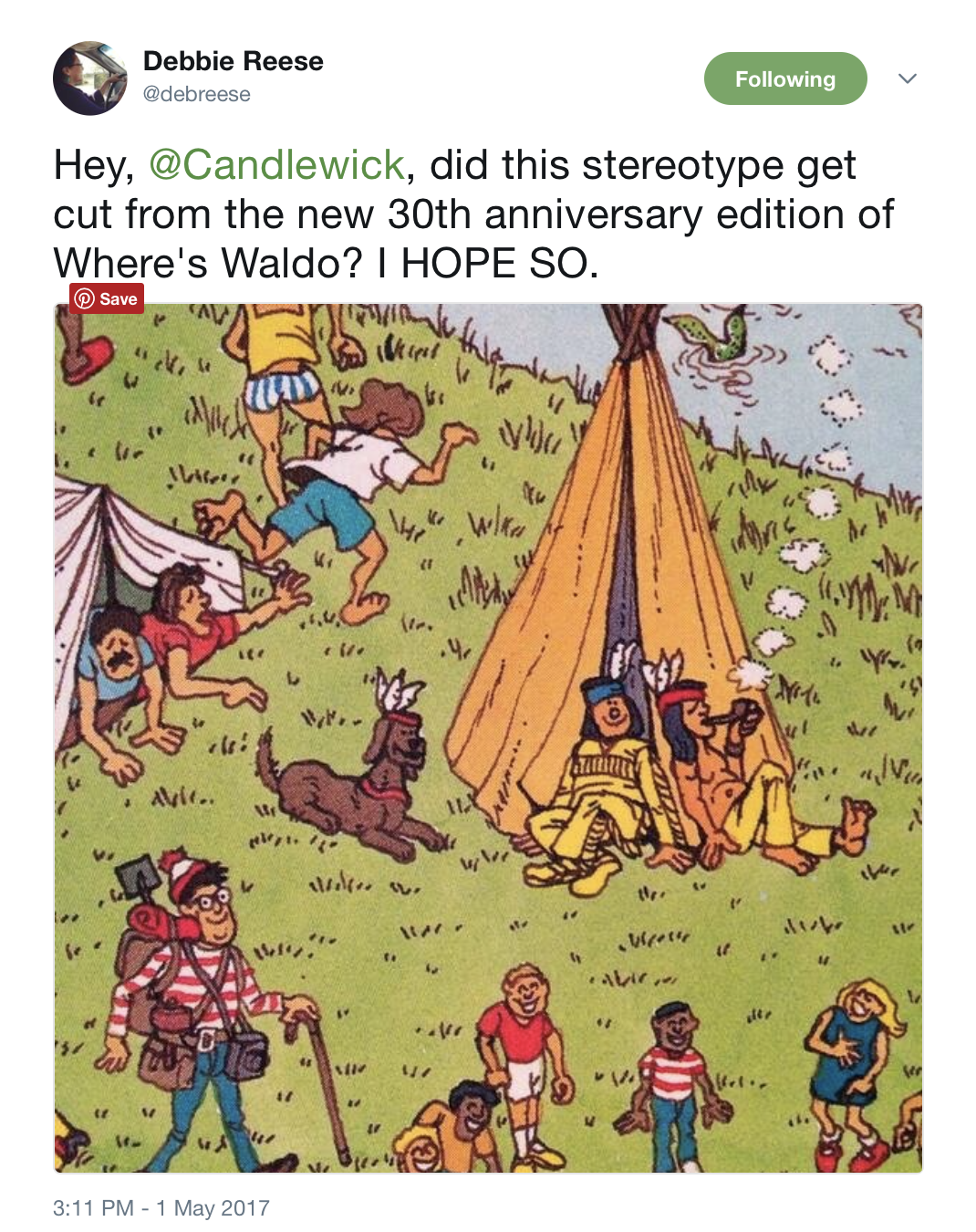
Martin Handford’s Where’s Waldo? (published as Where’s Wally? outside of the United States) turns 30 this year. To celebrate, Where’s Waldo? Destination Everywhere! will be released later this month. I first learned about the anniversary from Dr. Debbie Reese on Twitter:
Screen Shot 2017-09-02 at 2.09.55 PM.png
Debbie Reese's tweet reads, "Hey, @Candlewick, did this stereotype get cut from the new 30th anniversary edition of Where's Waldo? I HOPE SO."
The image featured in Reese’s tweet shows the backpack hauling, striped clothes & glasses-wearing Waldo character walking past a crowd, including two people lounging outside a tipi. They appear as stereotypes of First Nations/Native people, wearing generic headbands with feathers. One is smoking a pipe, and next to the pair is a brown dog with a headband and feathers atop its head. I did a double take after seeing the tweet, because I was a huge Waldo fan as a kid, and I did not remember that image from the series. As a child I owned a Waldo t-shirt, and as a school librarian I’ve probably checked out Waldo books to kids hundreds of times. I’ve even dressed up like Waldo for Halloween. But truth be told, it had been awhile since I’d spent time with the books. So today I sat down and did just that.


My first reaction at opening Where’s Waldo? was feeling overwhelmed and overstimulated. Overstimulation might be an understatement. I didn’t know where to look (that’s the point of a search and find book, I suppose). A reader could spend a good hour on one spread alone, looking and thinking and wondering about each drawing, character, setting, and situation. There is A LOT going on.
A chaotic sea illustration featuring the canoe scene described in the main text of the post.
There are a lot of sophomoric, goofy moments happening, as well as a bunch of cringe-worthy ones, including the image Reese shared in her tweet and this image showing another group of “Natives” paddling a canoe amidst chaos in the sea. Instead of lounging, this time they are in battle position: one has mouth agape and leg up, as if chanting, while his canoe-mates are either paddling or holding weapons at the ready. Reading this post Reese wrote several years ago helped me to clarify why the feathers and stereotypes represented here are so problematic.

The introduction page for "Trouble in Old Japan."
I noticed that people of color and First Nations/Native people are present in Handford’s books, but often when real settings and cultures are present they are also used as props or gimmicks, such as in Where’s Waldo Now? when Waldo travels the globe. The images from “Trouble in Old Japan,” in which Waldo comes upon sumo wrestlers and samurai, show how this setting-specific representation is also troubling.
An illustration of sumo wrestlers and samurai featuring Japanese stereotypes


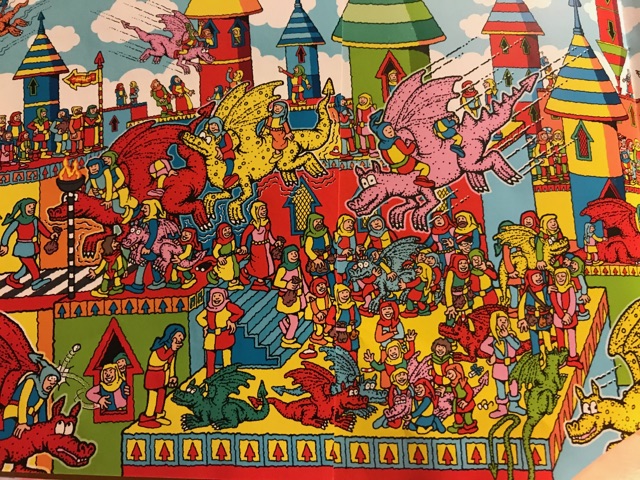
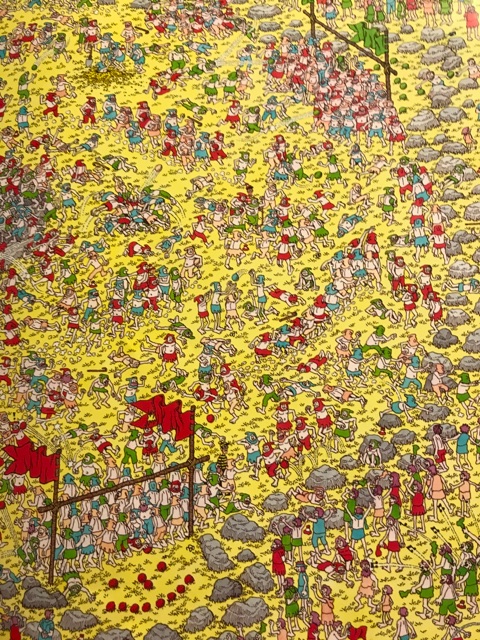
Many of Handford’s fantasy worlds in Where’s Waldo? The Fantastic Journey lack racial diversity and feature what appear to be huge crowds of White human characters. This subtly (and wrongly) communicates to First Nations/Native children, children of color, and White children that White is the default for representation - and in these make-believe stories, First Nations/Native children and children of color either do not exist or are not welcome.
waldofantastic1.jpg
A scene with flying dragons, a castle, and a White crowd of characters. 
waldofantastic2.jpg
A scene with many White characters wearing blue, green, or red clothing.


I’m sure that some will say that you can’t criticize the whole book or series because of a few images, or that these images are somehow less likely to be noticed on account of the clutter and topsy-turvy storytelling happening around them. I do believe that there is so much crammed into each spread that a reader might notice something different every time they read the book; that makes me aware that with more time examining these books, I’ll likely come to see additional elements of racism and other systems of oppression reflected in them. Even if we aren’t consciously taking all of the messages in at each read, we are seeing them and they are affecting us. I didn’t even REMEMBER these scenes from my childhood, but that doesn’t mean that they didn’t have a role to play in my socialization. It’s not that I didn’t see them, but rather that I didn’t notice them or understand them.


The publisher’s site for the 30th anniversary book promises “12 classic scenes as you’ve never seen them before,” and that has me wondering what willand hoping what will notbe reflected in those scenes. I’m not ashamed that kid-me loved these books, and in many ways I think Handford’s complex visual storytelling is part of why I’m so into visual narrative today. I am frustrated, however, that I didn’t have a teacher or role model to help me notice and question these images. I worry about how many teachers and caregivers today are looking at Waldo books and celebrations with children without reflections or critical conversations. A great anti-bias lesson in a classroom might be to look through these books and try to spot and discuss the -isms and -ias. A different kind of search and find book, if you will.